





If you notice any errors in the translations, remember:
"In the Legion, of the 144 languages, there is only one language: understanding each other."
Edito from PYC
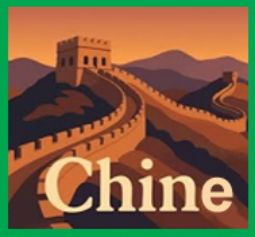
China is emerging from its century of humiliation.
And Europe?
By Louis Perez y Cid
There are nations that view their history as a memory. And then there are those that make it a policy. China clearly belongs to the second category.
To understand the Chinese power unfolding today, it is not enough to look at its factories, its technology companies, or its aircraft carriers. One must look back to the 19th century and understand this expression that remains at the heart of the Chinese national narrative: the "century of humiliation," bǎinián guóchǐ — 百年国耻.
From approximately 1839 to 1949, China experienced a succession of defeats, foreign interventions, territorial concessions, and infringements on its sovereignty. The Opium Wars, unequal treaties, foreign concessions, defeat at the hands of Japan, the Japanese invasion, and then the civil wars tell the story of a country that, for a century, ceased to be master of its own destiny.
The trauma began with the Opium Wars. Read more...
China is emerging from its century of humiliation. And Europe?
View of the elders

Letter from My Garden 18
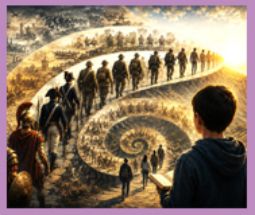
History repeats itself endlessly… but for how long?
Declaration:
Veterans reject and condemn:
- The blind conservatism or indifference of those who believe it possible to maintain certain privileges, to freeze economic and social development in its current state.
- The incitement (not the provocation) to violence, hatred, and passions.
- They unanimously agree to cry out to the nation, in these grave times it is going through, that the French, by dividing themselves, are making a mistake and would be guilty of a crime by... Read more...
History repeats itself endlessly… but for how long?
.jpg?t=aeb8a500_42ca_451a_ab7f_8e5528b4f20b)
Reflexions of the moment
Rwanda, Operation Turquoise
Foreword
Some of us had the honor of serving in Rwanda in 1994 as part of Operation Turquoise.
They went there with their weapons, their orders, and their soldiers' convictions, but above all with the mission to protect and save lives in the heart of a country ravaged by one of the most appalling tragedies of our time.
They discovered a reality that books and speeches can never fully convey: massacred populations, shattered families, abandoned children, terrorized men and women, and pervasive violence. Faced with this horror, they did not look away. They did their duty.
Operation Turquoise was a French military operation conducted under a United Nations mandate. Those who participated were deployed under particularly difficult conditions, with the constraints inherent in any military operation and the immense responsibility of having to make decisions and act in an emergency.
Yet, for decades, some have tried to portray these soldiers as complicit in the very thing they came to fight.
We reject this accusation. Read more...
Rwanda, Operation Turquoise

Share your point of view
We gladly welcome different opinions, provided they are expressed in a reasoned, respectful, and non-insulting manner.
Constructive exchanges are encouraged to promote dialogue and the enrichment of viewpoints.
This space allows you to respond to the content published on this site.
Literary Explorations
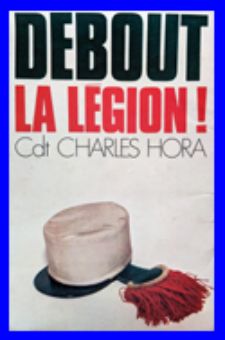
Battalion Commander Charles Hora
By Christian Morisot.
Each of us has the opportunity in our lives to experience moments of small joys and others of dramatic significance. It is always worthwhile to share them, even if they are primarily personal matters, kept deep within our very selective memories.
I enjoy frequenting antique shops, and my priority in my research is old books, particularly those written by former legionnaires. We once asked some of our veterans to recognize that they are veritable living memories and, therefore, to write about their past as legionnaires before embarking on their final journey. This request was not acted upon for numerous reasons that don't seem necessary to mention; it's an undeniable fact. However, many books have been written and remain little known.
Today, they are no longer published or are out of print or unavailable, as is the case for many of these books found at secondhand bookstores... Read more...
Battalion Commander Charles Hora
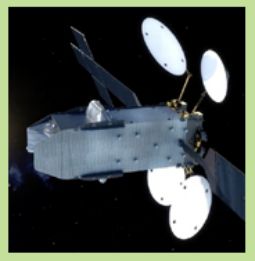
All this is above our heads
I'd like to call the number 22 in Asnières
By Michel Gravereau
Fernand Raynaud is still remembered for his sketch, "The number 22 in Asnières," where he desperately tried to make a phone call.
How ridiculous that seems today, in a world where children are practically born with the latest generation of cell phones in their cribs.
Telling our grandchildren about the epic journey a phone call represented in our youth is like taking a trip down memory lane, prompting an inquisitive look from them. "Are you sure you didn't take any drugs, Grandpa?"
Let's try to remember a few moments from our past.
The fledgling television service tried to keep us informed about Sunday's sports results, sometimes with footage filmed in stadiums, but sometimes we only got the score because the presenter at the time, Robert Chappatte or Roger Couderc, apologized for the report not arriving. The results of the horse races weren't any more reliable because the computers of the time lacked processing power. Read more...

I'd like to call the number 22 in Asnières

.jpg?t=aeb8a500_42ca_451a_ab7f_8e5528b4f20b)
Don't miss any of our publications and creations!
WHO WE ARE
Légion’Arts is an independent publishing house created by former legionnaire artists: preserving and sharing the memory of the Foreign Legion through authentic, human, and inspiring works. Every legionnaire has a voice. With Légion’Arts, these stories become a collective memory, accessible to all.