






Battalion Commander Charles Hora
By Christian Morisot.
Each of us has the opportunity in our lives to experience moments of small joys and others of dramatic significance. It is always worthwhile to share them, even if they are primarily personal matters, kept deep within our very selective memories.
I enjoy frequenting antique shops, and my priority in my research is old books, particularly those written by former legionnaires. We once asked some of our veterans to recognize that they are veritable living memories and, therefore, to write about their past as legionnaires before embarking on their final journey. This request was not acted upon for numerous reasons that don't seem necessary to mention; it's an undeniable fact. However, many books have been written and remain little known.
Today, they are no longer published or are out of print or unavailable, as is the case for many of these books found at secondhand bookstores... Read more...
The True Story of a False Journey
How Balzac, Jules Verne, and the Great Storytellers Teach Us to Travel Before We Even Leave
By Christian Morisot
I undoubtedly possess the great privilege of owning the complete collection of Balzac's works. One of the novels I recently read piqued my curiosity: "Voyage from Paris to Java."
Balzac never set foot outside of France, and yet his journey to Java is remarkable: "I confess that for a European, especially for a poet, no land could be as delightful as the island of Java! I will tell you about the things that were most vividly imprinted on my memory, but without order, according to my recollections!" (…)
Listening to Bengali songs, breathing in the scents of volcameria, running a half-dead hand through some Javanese hair, in the cool air, under a fiery sky, in the humid atmosphere that the Chinese know how to create by spreading long, wet rice straw mats before the windows of your tranquil palace… Read more...
I undoubtedly possess the great privilege of owning the complete collection of Balzac's works. One of the novels I recently read piqued my curiosity: "Voyage from Paris to Java."
Balzac never set foot outside of France, and yet his journey to Java is remarkable: "I confess that for a European, especially for a poet, no land could be as delightful as the island of Java! I will tell you about the things that were most vividly imprinted on my memory, but without order, according to my recollections!" (…)
Listening to Bengali songs, breathing in the scents of volcameria, running a half-dead hand through some Javanese hair, in the cool air, under a fiery sky, in the humid atmosphere that the Chinese know how to create by spreading long, wet rice straw mats before the windows of your tranquil palace… Read more...
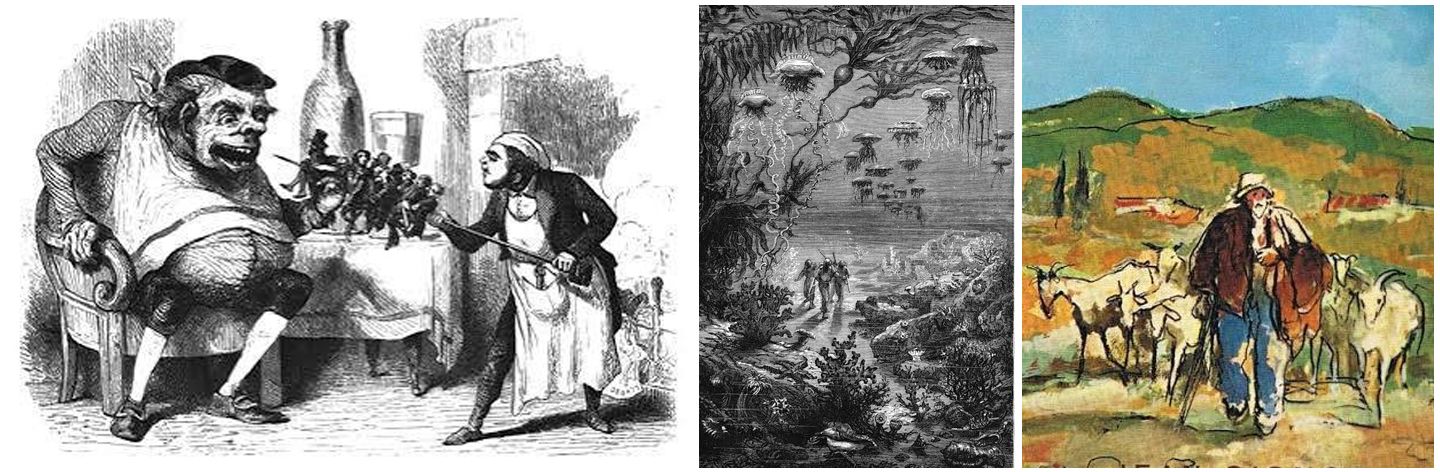
"The French in the Korean War"

All royalties will be donated to the Star of the Sea Children's Home in Inchon, South Korea.
This link provides direct access to the book:
https://editions-heimdal.fr/fr/apres-1945-moderne/1417-les-francais-de-la-guerre-de-coree-9782840486374.html
This link redirects you to the Editions Heimdal website to place your order:
https://editions-heimdal.fr/fr/
Orders can also be sent by mail. The book costs €69 including VAT, plus €7.50 shipping per order within France and €11.50 for Europe.
You can either use the attached order form or send your order to the publisher on a separate sheet of paper, clearly indicating your address and telephone number.

Louis Perez y Cid
Tintin,
An Unparalleled Negotiator
By Christian Morisot
It is true that Tintin is a fascinating subject of study. Michel Serres observed that the Belgian hero, drawn with simple strokes of the pen, can be likened to a mask that each of us can put on, whether young or old.
Tintin remains an emblematic hero of his time, with his share of darkness. The album *Tintin in the Congo* (1931) was notably "reissued in 2023 with a foreword explaining the colonial prejudices prevalent at the time of Hergé's first publication."
Despite this controversy, Tintin remains an icon. One facet of this character, however, is rarely discussed: his talent as a great negotiator. Throughout his adventures, this skill allows him to be likeable to the other characters in the comic strip, while still achieving his objectives. Read more...
It is true that Tintin is a fascinating subject of study. Michel Serres observed that the Belgian hero, drawn with simple strokes of the pen, can be likened to a mask that each of us can put on, whether young or old.
Tintin remains an emblematic hero of his time, with his share of darkness. The album *Tintin in the Congo* (1931) was notably "reissued in 2023 with a foreword explaining the colonial prejudices prevalent at the time of Hergé's first publication."
Despite this controversy, Tintin remains an icon. One facet of this character, however, is rarely discussed: his talent as a great negotiator. Throughout his adventures, this skill allows him to be likeable to the other characters in the comic strip, while still achieving his objectives. Read more...

The French of the Korean War
from Jean-François Pelletier
By Louis Perez y Cid
Our friend, Captain (ret.) Gérard Roux, president of AALE 63, Puy-de-Dôme, has shared this book with us, the work of one of its members of over fifteen years, Jean-François Pelletier.
When the author published "The French of the Korean War" with Heimdal publishers, he tackled a blind spot in French military history.
The Korean War remains a largely forgotten conflict in France, overshadowed by both the Second World War and the colonial wars that followed. In this respect, the book already possesses a crucial merit: that of bringing to light the commitment of the French Battalion of the UN and restoring the memory of these volunteers who went to fight on the other side of the world between 1950 and 1953. ...Read more...
Our friend, Captain (ret.) Gérard Roux, president of AALE 63, Puy-de-Dôme, has shared this book with us, the work of one of its members of over fifteen years, Jean-François Pelletier.
When the author published "The French of the Korean War" with Heimdal publishers, he tackled a blind spot in French military history.
The Korean War remains a largely forgotten conflict in France, overshadowed by both the Second World War and the colonial wars that followed. In this respect, the book already possesses a crucial merit: that of bringing to light the commitment of the French Battalion of the UN and restoring the memory of these volunteers who went to fight on the other side of the world between 1950 and 1953. ...Read more...
A Historical Novel Inspired by True Events
By Louis Perez y Cid
Our friend, Major (ret.) Jean Michel Houssin, president of the AALE (Association of Former Legionnaires) of Saône-et-Loire, is the author of several books devoted to the military world, and in particular to the French Foreign Legion.
Jean Michel is currently preparing an ambitious project in a new field for him: the historical novel inspired by true events within the French Foreign Legion.
A more personal detail concerning his upcoming publishing project deserves to be shared today. The author is currently working on the publication of a historical novel recounting two real events that took place within the French Foreign Legion between 1941 and 1945.
After several discussions, he found a reputable publisher willing to support him in this endeavor, Éditions Vérone, through a collaborative publishing agreement... Read more...
The LEGIONAR Trilogy
Thanks to our friend Mickaël de Prat, Légion'Arts is pleased to highlight a new author, a former legionnaire, whose unique journey and human experience enrich the spirit and values upheld by our community.
Louis Perez y Cid
By Branko Bencic
LEGIONAR is a trilogy about a journey within the French Foreign Legion and the lasting impact such an experience has on a man. In a personal, understated, and well-researched style, it follows the entry into a world apart, governed by its own rules, then the training, service, responsibility, the limits of endurance, camaraderie, and the gradual inner development of a man who, through experience, learns his own limits. Read more...

ENLIST The 11th Foreign Infantry Regiment
The new book by retired Major Jean-Michel Houssin on the history of the 11th REI
By Louis Perez y Cid.
The 11th REI was born in the urgency of spring 1940, when France was trying to contain the German offensive. Formed of volunteers from many countries, the regiment embodies the very spirit of the Foreign Legion: men without the same language or origin, but united under the same flag.
The 11th REI was born in the urgency of spring 1940, when France was trying to contain the German offensive. Formed of volunteers from many countries, the regiment embodies the very spirit of the Foreign Legion: men without the same language or origin, but united under the same flag.
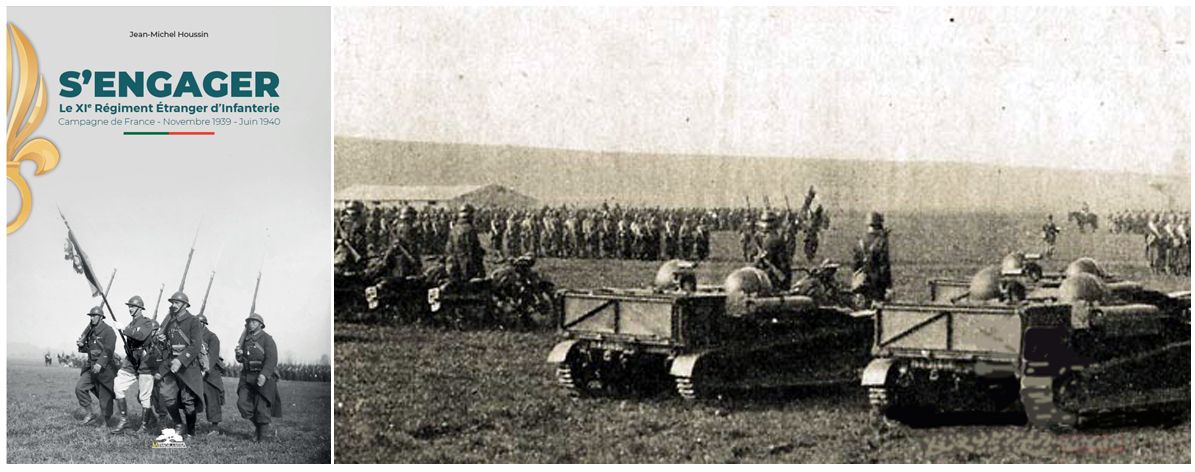
Barely formed, the 11th REI was thrown into battle. The legionnaires fought almost relentlessly during the Battle of France, often outnumbered and under constant pressure. Despite bombardments, encirclement, and very heavy losses, the regiment held its positions and fought fiercely...Read more...
“The Legion Beyond the Myth”
The French Foreign Legion 1831-1962 by Douglas Porch
By Louis Perez y Cid
The French Foreign Legion is often recounted through its battles, traditions, and legends. But what remains when the filter of the narrative is removed? Douglas Porch’s book offers an uncompromising exploration of the corps’ true history, from its creation to its establishment as an elite force.
There are two ways to read this book: from the outside… or with a legionnaire’s background. And in the latter case, it takes on a whole new dimension.
Published in 1991 in the United States and then translated into French in 1994, Douglas Porch’s work remains, even today, one of the few comprehensive studies on the French Foreign Legion. Not a story told to perpetuate the legend, but a story written without filters, in all its continuity. This is precisely what makes it a major work. Read more...
The French Foreign Legion is often recounted through its battles, traditions, and legends. But what remains when the filter of the narrative is removed? Douglas Porch’s book offers an uncompromising exploration of the corps’ true history, from its creation to its establishment as an elite force.
There are two ways to read this book: from the outside… or with a legionnaire’s background. And in the latter case, it takes on a whole new dimension.
Published in 1991 in the United States and then translated into French in 1994, Douglas Porch’s work remains, even today, one of the few comprehensive studies on the French Foreign Legion. Not a story told to perpetuate the legend, but a story written without filters, in all its continuity. This is precisely what makes it a major work. Read more...

Charles Favrel
A Legionnaire… or a Witness in Uniform?
By Louis Perez y Cid
There are undoubtedly two ways to join the French Foreign Legion: to belong to it, or to experience it firsthand.
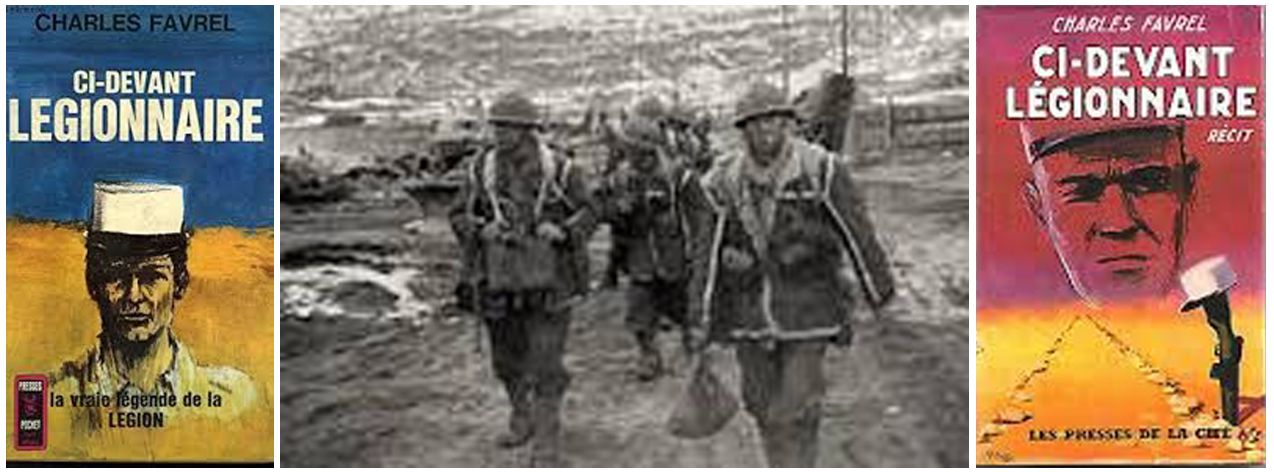
Upon reading *Ci-devant légionnaire* (Former Legionnaire), a question quickly arises: Was Charles Favrel a legionnaire like any other, or a man who came to the Legion seeking an experience to live… and to understand?
From the outset, Favrel himself provides part of the answer. At 35, he describes his enlistment as “one last foolish act” intended to crown a turbulent youth. The tone is set: no grand heroic speeches, no dramatic break with the past. On the contrary, a kind of lucidity, almost irony. ...Read more...
The Book of Camerone
By Louis Perez y Cid
Book by Alain Gandy, published by Presses de la Cité, 1995
As Camerone approaches, it seemed natural to pay tribute to the man as much as to the writer.
Alain Gandy was not only a renowned author, but above all a soldier with an unusual career. An officer who enlisted during the Battle of France in World War II, he later served in Indochina and then Algeria. It was there that he made a rare choice: to leave his officer's rank and enlist as a simple legionnaire.
This choice speaks volumes about the man.
He then continued his... Read more...

ERWIN
Legio Patria Nostra
By Louis Perez y Cid.
A book by Martine Trouillet.
Erwin was seventeen when he left St. Gallen, his family, without explanation, to go to Austria and join the French Foreign Legion. There, he discovered another life: military campaigns, Indochina, Algeria, and silent loyalty.
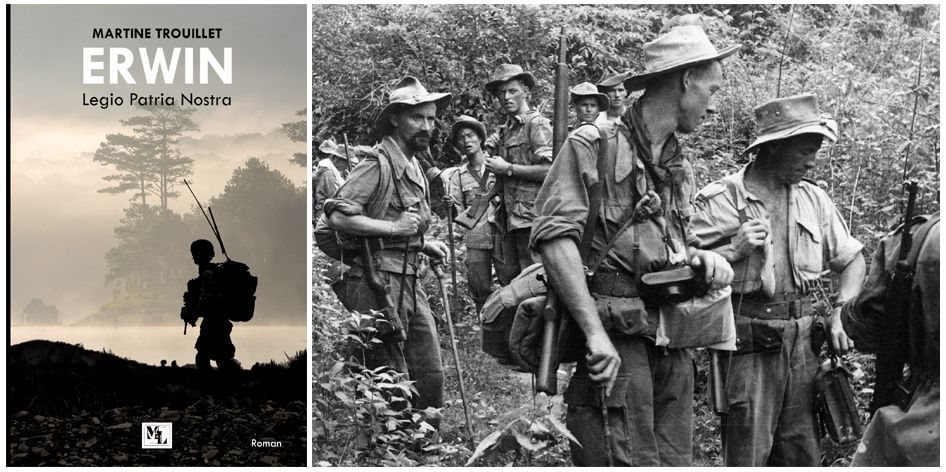
Years later, he settled in France. Life flowed by quietly. At the end of his life, he chose Clémence as his heir. She never really knew him. He had shared her mother's life for a time, without ever fully taking her place. ...Read more...
Legionary Songs
By Christian Morisot
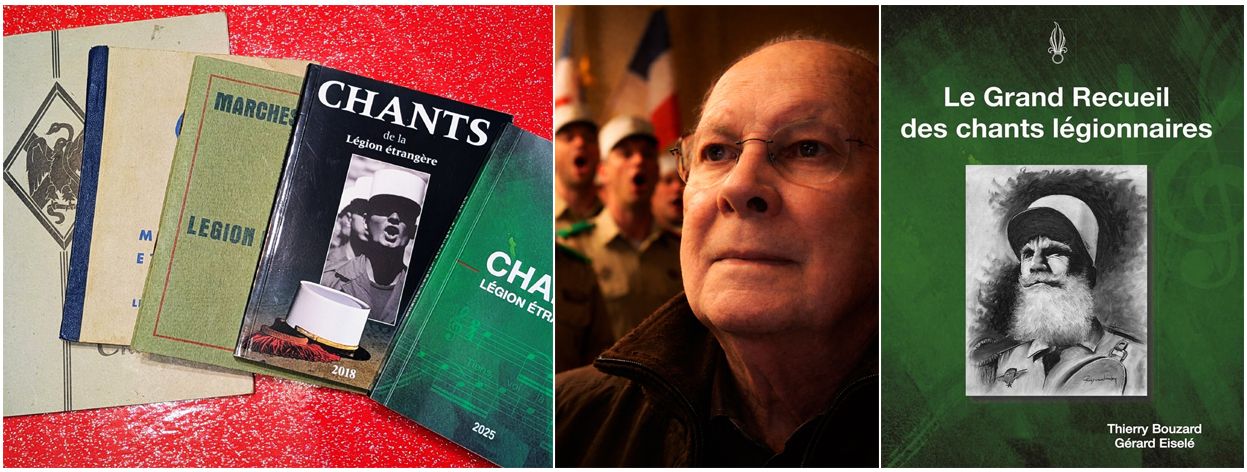
I received as a gift the book "The Collection of Legionary Songs," published by the company "D'un autre ailleurs" (From Another Elsewhere).
Legionary song is a living tradition with global reach. The French Foreign Legion stands with them at the crossroads of military history and human fraternity, embodying a unique spirit.
I have kept some songbooks and, as a result, I have observed an evolution in the songs recorded. While it is true that song plays a role in fostering cohesion, it is important to note that it is above all an ancestral practice with a beneficial influence on the individual, an influence that is amplified when they are in a group. Song presents itself as a collective harmony that acts through time; the singer is thus in communion with all those who have performed the songs before them, the forces of the past helping them to face current challenges. ... Read more...
“Mona’s Eyes”
By Christian Morisot
I recently acquired a book I absolutely loved: the illustrated version of “Mona’s Eyes,” published by Albin Michel in the Beaux-Arts series, featuring over 160 reproductions
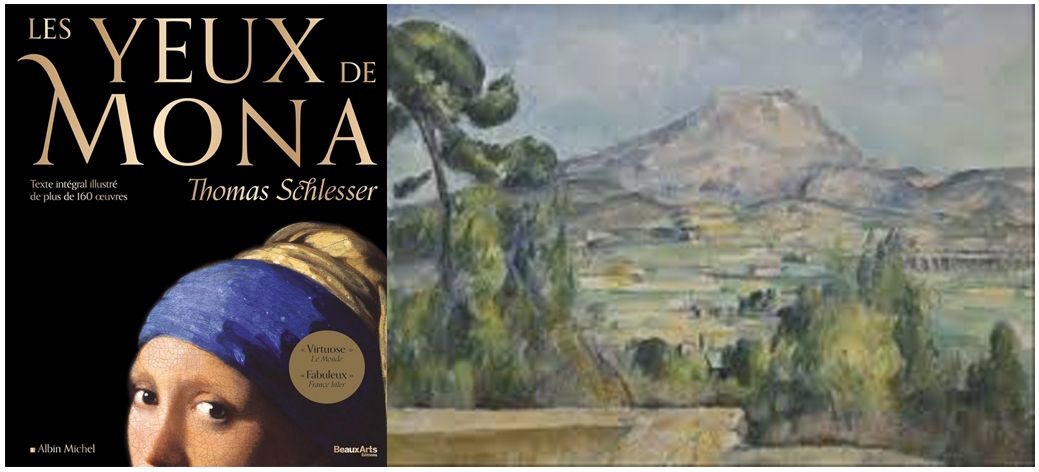
The premise is original: “Mona has fifty-two weeks left before she goes blind. Her grandfather wants to show her the world through paintings in the Musée d’Orsay and elsewhere, helping her to remember and appreciate the beauty of this world through art.” ... Read more...
March 10, 1831 in Comics
By Louis Perez y Cid
The first story in the comic book series "It's the Legion" takes us back to the origins of the French Foreign Legion. It recounts its creation and its baptism of fire in the French possessions in Africa, the future Algeria.
A tragic baptism.
In the heat of battle, Lieutenant Cham falls under enemy fire. He thus becomes the first Legion officer to die in combat… the first name on a long and painful list etched in the Legion's memory.

The second story transports us much later, to 1997, to the heart of the jungle in French Guiana.
During a deep mission near marker 6, a half-section of legionnaires finds themselves isolated in the vastness of the Amazon rainforest. A serious accident occurs. The situation is critical.
Then came an order, simple and absolute ... Read more...
During a deep mission near marker 6, a half-section of legionnaires finds themselves isolated in the vastness of the Amazon rainforest. A serious accident occurs. The situation is critical.
Then came an order, simple and absolute ... Read more...
The 18
Based on the true story of Fernando Magellan's voyage
A graphic novel series by Louis Perez y Cid.
In 1519, 240 men set sail from Seville. Seasoned sailors, inexperienced foreigners, men haunted by their past, and children.
Five ships embarked for the Ocean Sea under the command of Fernand Magellan.
No one knew their true destination. Two years' worth of provisions were on board.
The maps stopped where their route began. They set off into the void.
Three years later, only one ship returned, carrying several tons of cloves and… 18 survivors.
Captain Juan Sebastián Elcano completed the first circumnavigation of the globe in history.
But between departure and return, there was no glory.
There is hunger, fear, betrayal, cold, suffocating heat, mutiny, fighting, and blood—lots of blood.
.jpg?t=aeb8a500_42ca_451a_ab7f_8e5528b4f20b)
This is not a legend. It's worse.
The Beast and Us
Security, Sovereignty, Freedom
By Louis Perez y Cid
In 1945, Europe discovered not only that it had lost a war, but also that it had allowed itself to be drawn into absolute savagery.
Cultured, industrialized, and structured nations, endowed with prestigious universities and brilliant engineers, slid toward the abyss without the collapse initially seeming inevitable. The question, therefore, is not simply, who is at fault? But the more disturbing one: how could modern societies have consented?
Taking refuge in Switzerland during the conflict, the French journalist Bertrand de Jouvenel published *Du Pouvoir* (On Power) in 1945. He was not looking for an isolated monster, but analyzing a dynamic.
Political power, he explained, naturally tends to expand. He called it the "Beast."
The term is not excessive; it is precise.
The Beast does not refer to a particular regime, but to the logic by which power grows when circumstances justify it and when citizens accept it. History shows that this process never begins with brutality, but with necessity... Read more...
In 1945, Europe discovered not only that it had lost a war, but also that it had allowed itself to be drawn into absolute savagery.
Cultured, industrialized, and structured nations, endowed with prestigious universities and brilliant engineers, slid toward the abyss without the collapse initially seeming inevitable. The question, therefore, is not simply, who is at fault? But the more disturbing one: how could modern societies have consented?
Taking refuge in Switzerland during the conflict, the French journalist Bertrand de Jouvenel published *Du Pouvoir* (On Power) in 1945. He was not looking for an isolated monster, but analyzing a dynamic.
Political power, he explained, naturally tends to expand. He called it the "Beast."
The term is not excessive; it is precise.
The Beast does not refer to a particular regime, but to the logic by which power grows when circumstances justify it and when citizens accept it. History shows that this process never begins with brutality, but with necessity... Read more...
_(1).jpg?t=aeb8a500_42ca_451a_ab7f_8e5528b4f20b)
The Anxious Generation
by Jonathan Haidt
By Louis Perez y Cid
My friend Patrice Valantin's IRVIN association (see the Facts section) discusses this book. What is it about?
Published in 2024, The Anxious Generation makes a strong case: the widespread use of smartphones and social media, combined with more protective parenting, has profoundly altered the development of young people and contributed to the rise in anxiety and depressive disorders observed since the early 2010s.
My friend Patrice Valantin's IRVIN association (see the Facts section) discusses this book. What is it about?
Published in 2024, The Anxious Generation makes a strong case: the widespread use of smartphones and social media, combined with more protective parenting, has profoundly altered the development of young people and contributed to the rise in anxiety and depressive disorders observed since the early 2010s.

A clear social diagnosis
Haidt speaks of a "great rewiring" of childhood: less free play, fewer face-to-face interactions, and more digital socialization. He draws on epidemiological data and psychological research to demonstrate a temporal correlation between the... Read more...
Valiant Women
The Sentinels of the Legionnaires
By Louis Perez y Cid
“Daddy, Why Are You Leaving?” was a book for children. For those who wait. For those who experience absence without always having the words to express it. It gave a voice to a silent pain, seen from a child’s perspective.
With Valiant Women, the focus now turns to those who remain. The wives and partners of legionnaires. Those who bear the burden of waiting every day, who keep the home going, who learn to live with distance, worry, and hope. This book is theirs, a testament to strength, courage, and resilience, to make visible those who, in the shadows, watch over them.
“Daddy, Why Are You Leaving?” was a book for children. For those who wait. For those who experience absence without always having the words to express it. It gave a voice to a silent pain, seen from a child’s perspective.
With Valiant Women, the focus now turns to those who remain. The wives and partners of legionnaires. Those who bear the burden of waiting every day, who keep the home going, who learn to live with distance, worry, and hope. This book is theirs, a testament to strength, courage, and resilience, to make visible those who, in the shadows, watch over them.
_(1).jpg?t=aeb8a500_42ca_451a_ab7f_8e5528b4f20b)
Maylis Lardet and Marie-Laure Vincensini have written a book that is as necessary as it is profoundly human. The first book entirely devoted to the wives and partners of legionnaires, it fills a long-standing silence surrounding those who experience the Legion from within, without a uniform, but with remarkable resilience. Read more...
“Daddy, Why Are You Leaving?” Why is this children’s book on our site?
By Louis Perez y Cid
“Daddy, Why Are You Leaving?” is a children’s book written by a young author. It has its rightful place on our site primarily because its story is deeply intertwined with our own.
Its author, Marion Maloigne, is a fellow service member of the French Air Force. Like so many service members, she had to deploy, leaving behind what she held most dear: her family. As a mother, she experienced the separation not only with her adult heart, but also through the eyes of her child.
From this ordeal, a certainty emerged. By blending her own experience with her passion for literature, she chose to write for children. For those who are waiting. For those who feel the absence without always being able to name it. For our children.
“Every day, hundreds of men and women are sent far from home. Of course, we think of them and support them, but what about those who stay behind? What about those little ones who suffer in silence?
As a mother, I saw the terrible sadness in my little boy’s eyes. What a heartbreaking ordeal for a parent to witness this powerful rift taking root in the hearts of our children. I couldn’t leave my son in such a heavy sorrow, and it’s thanks to these kinds of little stories that I was able to help him heal.”
Marion Maloigne Read more...
.jpg?t=aeb8a500_42ca_451a_ab7f_8e5528b4f20b)
Comics, the Meaning of Life
Unlike many politicians, our friend Christian keeps his promises. The second post on comics is still fresh off the press. He doesn't do this half-heartedly; there are no half measures. You can tell he's a comic book addict; he knows his stuff… Many years ago, he took me through the streets of Aix-en-Provence to show me a bookstore specializing in them. He probably doesn't remember it anymore, but I remember it very well, so astonished was I by the owners' passion for the world of comics, as if surprised by the glee in Christian's eyes. These comics aren't for kids; they're very adult and very serious.
I humbly confess that I never thought I could elevate my mind to such a degree—like on Jacob's Ladder, which he mentions—thanks to comics. But come to think of it… who knows!
Today he's talking about Calvin, complete with his tiger and his famous box. He feels literally hypnotized by the box's contents. As he himself says, it's a veritable Pandora's box where you find everything that can affect us in life.
A marvelous world where you can dive headfirst without being mistaken for an old man having a midlife crisis.
Our friend Christian has more in store for us…
Antoine Marquet.
Comics. Calvin and Hobbes
“Irregular Men” The Journey of a Man, from Legionnaire to Priest
Published in 2006, this book by Étienne de Montety, then deputy editor of Figaro Magazine, is the result of three years of research with former members of the French Foreign Legion. Through thirteen unique stories, it recounts the rupture, the ordeal, and the rebuilding. Often from elsewhere, these men remind us that nothing is ever truly over.
In this Christmas season, conducive to reflection, it seemed fitting to evoke one of them, whose journey is profoundly human: Father Jorge Saavedra.
In this article, Christian recounts with simplicity his encounter with this discreet man, whose spiritual path, shaped by trials and decisive encounters, finds its light at the very heart of the French Foreign Legion.
Louis Perez y Cid
A Man's Journey, from Legionnaire to Priest
Collected by Christian Morisot
As Director of the Foreign Legion Veterans' Home, I found myself in a very delicate situation: I had no priest to officiate at the funeral of one of our residents who had recently passed away.
From memory, I knew that a priest, a former legionnaire, was in Aix-en-Provence. It was noted that he was a very discreet man who lived in a small attic apartment near the cathedral.
Thus, responding to my request, I met Father Jorge Saavedra, who agreed to celebrate this religious tribute to our veteran in the Institution's chapel.
Afterwards, the opportunity arose to get to know each other better. Read more...
As Director of the Foreign Legion Veterans' Home, I found myself in a very delicate situation: I had no priest to officiate at the funeral of one of our residents who had recently passed away.
From memory, I knew that a priest, a former legionnaire, was in Aix-en-Provence. It was noted that he was a very discreet man who lived in a small attic apartment near the cathedral.
Thus, responding to my request, I met Father Jorge Saavedra, who agreed to celebrate this religious tribute to our veteran in the Institution's chapel.
Afterwards, the opportunity arose to get to know each other better. Read more...
What the West Refuses to See
Some books are disturbing because they hit the nail on the head. The Camp of the Saints is one of them. For over fifty years, Jean Raspail's novel has been vilified, not for what it is, but for what it forces us to confront.
In this article, Antoine offers a frank rereading of this reviled work in light of contemporary realities. This is neither about indulgence nor demonization, but about an observation: by refusing debate, our societies have replaced lucidity with denial.
Whether one agrees with or rejects Raspail's arguments, one thing remains: ignoring the warnings never makes them obsolete. This article invites us to break the silence before it becomes irreversible.
Louis Perez y Cid
In this article, Antoine offers a frank rereading of this reviled work in light of contemporary realities. This is neither about indulgence nor demonization, but about an observation: by refusing debate, our societies have replaced lucidity with denial.
Whether one agrees with or rejects Raspail's arguments, one thing remains: ignoring the warnings never makes them obsolete. This article invites us to break the silence before it becomes irreversible.
Louis Perez y Cid
The Camp of the Saints
Antoine Marquet (Lieutenant Colonel TE-er)
As editor-in-chief of Képi Blanc magazine, I was, among other things, responsible for reviewing literary works submitted to me for the magazine's readers. For a long time, I was tempted to review The Camp of the Saints by Jean Raspail, ambassador of Patagonia, journalist, and writer. I confess that I censored myself in order to avoid attracting potentially damaging criticism to the magazine. The movement of ... Read more...
As editor-in-chief of Képi Blanc magazine, I was, among other things, responsible for reviewing literary works submitted to me for the magazine's readers. For a long time, I was tempted to review The Camp of the Saints by Jean Raspail, ambassador of Patagonia, journalist, and writer. I confess that I censored myself in order to avoid attracting potentially damaging criticism to the magazine. The movement of ... Read more...
Alexandra David-Néel
“To be fiercely opposed to any leveling down.”
Our friend is indulging himself today, venturing into the philosophical realms he so loves, by evoking and sharing with us the reflections of Alexandra David-Néel… who, known as Alexandra, was actually named Alexandrine. A writer and explorer, a renowned orientalist, this woman led an absolutely extraordinary life. Born in Saint-Mandé, she died in Digne, but between these two cities she traveled extensively throughout the Far East, where she was a leading authority. What an extraordinary destiny for someone who, initially, was named Alexandrine… a sort of verse with two sets of six syllables… in the feminine form…
Antoine Marquet
By Christian Morisot
Alexandra David-Néel said: “The greatest service one could render to a human being was to make them intelligent. Helping people rise up didn't mean giving them money, but culture, a well-formed mind. Giving money to a fool is useless; they don't know how to spend it. The rich shouldn't fall down the social ladder, but it was the poor who should rise. One must be fiercely opposed to any leveling down.”
Read more...
.jpg?t=aeb8a500_42ca_451a_ab7f_8e5528b4f20b)
.jpg?t=aeb8a500_42ca_451a_ab7f_8e5528b4f20b)
Hannah Arendt
Reflections following the CEMA's remarks: Seventy years ago, the philosopher Hannah Arendt, who fled Nazi Germany, warned us. Her warning was not that lies would prevail, but that people would become too exhausted to care about what is true.
Hannah Arendt didn't study totalitarianism from books. She fled from it.
Born in 1906 in Germany, in a world of ideas and debates, she studied philosophy under some of the greatest minds of the twentieth century, Martin Heidegger and Karl Jaspers. Then the Nazis came to power.
In 1933, this Jewish intellectual was briefly arrested by the Gestapo. Released after a week, she understood what was coming. She fled Germany illegally, passing through Czechoslovakia and then France. When France fell in 1940, she was interned in a camp. She escaped during the chaos of the French collapse. With emergency visas, forged documents, and desperate courage, she crossed borders as Europe burned. She reached Portugal, and finally New York in 1941.
She survived. But she never forgot what she had seen. Read more...