






Response to PYC's Editorial
on "The Famous Women's Section"
By Christian Morisot
Louis offers us a beautiful reflection that touches on a real controversy: the place of women within our veterans' associations. I am reminded of the reaction during the vast period between the two World Wars, when a married man could not be considered a good non-commissioned officer in the Legion simply because he was "handicapped" by having something to lose, which placed him on the margins of what was expected of the legionnaire's ferocious fighting spirit and his disdain for death.
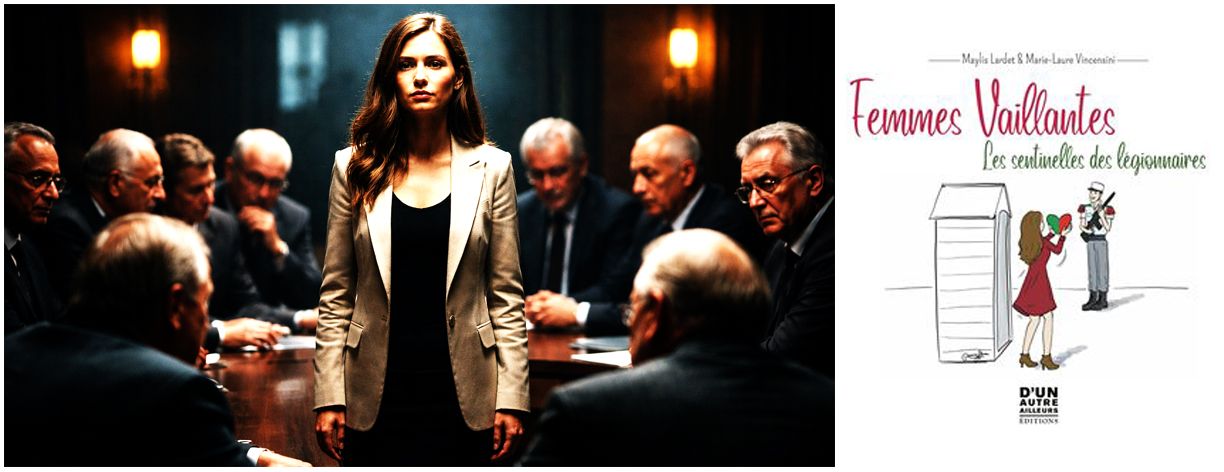
In a book about the wives and partners of legionnaires, "Valiant Women," Maylis Lardet and Marie-Laure Vincensini present a testimony that brings to light those who are in the shadows of the light within our community, our "Legion family."
Another book: "Dad, Why Are You Leaving?" Marion Maloigne's statement also answers a question posed by a child in an essential dialogue between parents and children.
But let's not get sidetracked; PyC, in his remarks, justifies, defends, and explains the reasons for a women's section within the association he presides over. This initiative is, in fact, a reaction, among other things, to a text written by an officer, the regional delegate of the FSALE (Federation of Former Legionnaires' Associations), who outlines a vision of veterans' associations that seems, as Antoine Marquet so aptly puts it, "frozen in the cement of the last century, while the world has shifted into hyper-connectivity and individual autonomy."
A project in the form of a "work assignment"—a veritable semantic utopia—with a question-observation: are wives a variant of adjustment or members of the extended Legion family? This unconventional delegate explains that the place given to sympathizers and women is simultaneously marginal, distrustful, and fundamentally utilitarian.
Finally, to understand PyC's initiative, it is necessary to observe the lives of our residents in Puyloubier and even Auriol. While they appear fraternal and supportive of one another, it remains true that they are isolated. In Puyloubier, in particular, they are very self-conscious about the way visitors look at them, to the point that some of the older residents loudly proclaim: "The Institution is not a zoo, and the workshops are not just there to make people cry..."
Fortunately, against all odds, a women's section was created, much to the delight of the residents, who eventually accepted it, finding in it a chance for someone to still exist, especially since it's always better to have a caring woman around than a veteran rambling on about his campaigns. Legion memories are certainly not lacking for them either…
As the former director of the two residences for former Legionnaires, I was very concerned about providing support for the residents' leisure activities and outings. I felt it was essential to avoid any idleness, a source of depression, and the presence of women, and even that of sympathizers, by a kind of absorbent effect, immediately brought great and healthy satisfaction through the cultural choices adopted and offered to the veterans, who readily participated.
Preserving Legion identity is not about building ever-higher, insurmountable walls, but about knowing who you are. The members of the associations are the sole judges of the articles included in their statutes, and those of the Puyloubier association exclude no one. Well done!
But let's not get sidetracked; PyC, in his remarks, justifies, defends, and explains the reasons for a women's section within the association he presides over. This initiative is, in fact, a reaction, among other things, to a text written by an officer, the regional delegate of the FSALE (Federation of Former Legionnaires' Associations), who outlines a vision of veterans' associations that seems, as Antoine Marquet so aptly puts it, "frozen in the cement of the last century, while the world has shifted into hyper-connectivity and individual autonomy."
A project in the form of a "work assignment"—a veritable semantic utopia—with a question-observation: are wives a variant of adjustment or members of the extended Legion family? This unconventional delegate explains that the place given to sympathizers and women is simultaneously marginal, distrustful, and fundamentally utilitarian.
Finally, to understand PyC's initiative, it is necessary to observe the lives of our residents in Puyloubier and even Auriol. While they appear fraternal and supportive of one another, it remains true that they are isolated. In Puyloubier, in particular, they are very self-conscious about the way visitors look at them, to the point that some of the older residents loudly proclaim: "The Institution is not a zoo, and the workshops are not just there to make people cry..."
Fortunately, against all odds, a women's section was created, much to the delight of the residents, who eventually accepted it, finding in it a chance for someone to still exist, especially since it's always better to have a caring woman around than a veteran rambling on about his campaigns. Legion memories are certainly not lacking for them either…
As the former director of the two residences for former Legionnaires, I was very concerned about providing support for the residents' leisure activities and outings. I felt it was essential to avoid any idleness, a source of depression, and the presence of women, and even that of sympathizers, by a kind of absorbent effect, immediately brought great and healthy satisfaction through the cultural choices adopted and offered to the veterans, who readily participated.
Preserving Legion identity is not about building ever-higher, insurmountable walls, but about knowing who you are. The members of the associations are the sole judges of the articles included in their statutes, and those of the Puyloubier association exclude no one. Well done!