






General Rollet. 1/2
By Christian Morisot
We are entering the month of our Camerone commemoration and that of the death of General Paul-Frédéric Rollet on April 16, 1941. As Camerone begins, it seems worthwhile to highlight an exceptional man, the "first Legionnaire of France": worldwide:
It all began in 1875, the year Paul-Frédéric Rollet was born. His father, assigned to the 46th Line Infantry Regiment in Auxerre, was a captain, a rank awarded in 1871 as an exceptional measure due to his conduct during the Franco-Prussian War of 1870-71. Undoubtedly, the influence of his father—for whom he harbored a true veneration—naturally led him to choose a military career.
A second approach also seems interesting: the fact that he found himself several times under the command of the famous Commandant Brundsaux, whose effigy, wearing a colonial helmet of the Madagascar or Dahomey type, is one of the bearded, giant sentinels guarding our war memorial in Aubagne. Finally, during his numerous postings in Madagascar, Algeria, and Morocco, he met the man who would become one of his friends: Louis Hubert Gonzalve Lyautey. All those who had the privilege of knowing Marshal Lyautey could not remain indifferent to this exceptional man, endowed with real power and extraordinary charisma.
The young Lieutenant Rollet could not have had a better role model than this officer of remarkable character. Shortly after joining the officer corps, Lieutenant Lyautey demonstrated his strong personality by boldly publishing, in 1891 in the *Revue des Deux Mondes*, "The Social Role of the Officer," in which he outlined his humanist vision of the Army. This book revolutionized the military and civilian world of the time and influenced an entire generation of officers.
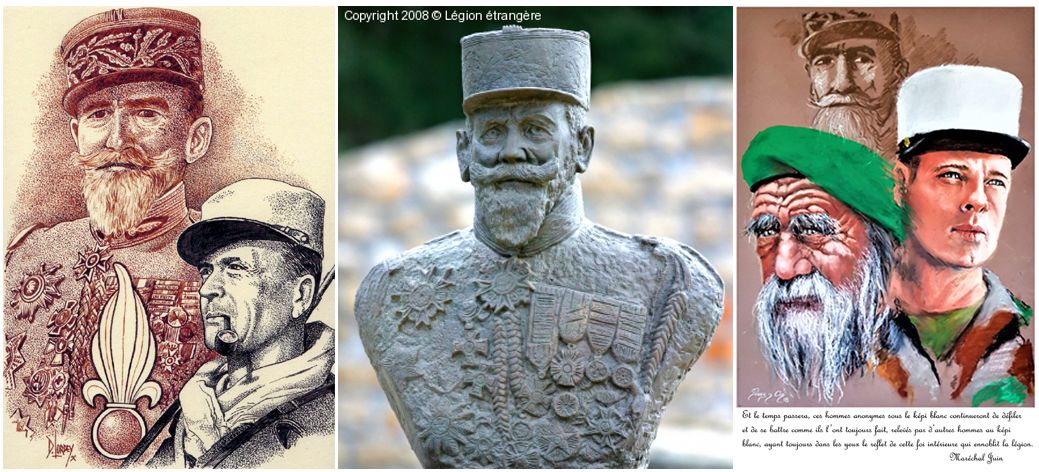
However, regarding General Rollet's social initiatives, it was only from 1925 onward, when he was commanding officer of the 1st Foreign Infantry Regiment, that a real need arose to organize the "post-Legion" life of legionnaires returning to civilian life. For him, this represented a true sense of responsibility; the lack of social support for legionnaires struck him as a significant void. A simple observation presents itself: one need only open the famous "Golden Book of the Foreign Legion," specifically the 1931 edition. It comprises exactly 374 pages, and only two of them are dedicated to "mutual aid and assistance organizations, societies of former legionnaires," the FSALE of the time. Even then, after removing the superfluous and unnecessary entries, very little is devoted to social action.
Of course, there was the "Arzew Rest Center," which, incidentally, lasted 34 years, as well as the one in Salé, Morocco, a 20-bed "accommodation center" in Marseille at 21 rue des 13 escaliers, and, in 1933, the retirement home in Auriol, known as "the little international village of La Vède." Of course, many released legionnaires remained in Algeria or Morocco, but with a force of over 22,000 men, the Legion was releasing nearly a hundred new "former legionnaires" each month onto the docks of Marseille, leaving them to fend for themselves. When the global economic crisis erupted in 1929, an uncontrollable wave of unemployment swept across Europe. This situation could not improve the circumstances of the legionnaires "returned" to civilian life.
To better understand the repercussions of this global debacle on the lives of former legionnaires in metropolitan France, General Rollet, in 1932, asked Captain Rollin, head of the Legion's Registration Service in Marseille, to conduct a thorough and uncompromising study of the conditions under which legionnaires returned to civilian life, and especially of possible improvements.
Maintaining close ties with veterans' associations, Captain Rollin carried out his mission and reported the results of his investigations to the General shortly thereafter. The findings were extremely harsh and, above all, unequivocal! They revealed a horrific ordeal of administrative formalities for foreigners who were unaware of their rights, who had a poor command of French, and who didn't know where or whom to turn to. One thing was clear: the newly released veterans desperately needed support; they could not, and did not know how to, exercise their rights on their own.
The General was convinced that the Legion could no longer ignore the fate of its former members, especially since he believed that providing substantial assistance to the veterans would boost the morale of active-duty legionnaires, who would see, with great relief, the opportunity to no longer dread their departure from the Legion that, he specifies, is also part of the Legion's family spirit.
These men, discharged from their Legion service, could not understand why they could not find organized official assistance upon their release, in a country whose greatness they had contributed at least five years of their youth to, leading a very hard life and paying a heavy price, often with their blood.
In the monthly magazine "La Légion étrangère" in 1931, a former warrant officer expressed himself in these terms: "Should I, a former Legionnaire with 11 years of service, a recipient of the Military Medal, beg in the street, or let myself be arrested for vagrancy, then escorted to the border between two gendarmes, or should I commit suicide?" “Aware of the gravity of the situation, the General decided to initially focus his efforts on the following objectives:
• Ensuring that retirees and those discharged from service have the means to rebuild their lives free from poverty,
• Maintaining the “Legion spirit” among veterans by fostering bonds that connect them to the Legion family,
• Facilitating a smoother transition from military to civilian life;
Read more…
Of course, there was the "Arzew Rest Center," which, incidentally, lasted 34 years, as well as the one in Salé, Morocco, a 20-bed "accommodation center" in Marseille at 21 rue des 13 escaliers, and, in 1933, the retirement home in Auriol, known as "the little international village of La Vède." Of course, many released legionnaires remained in Algeria or Morocco, but with a force of over 22,000 men, the Legion was releasing nearly a hundred new "former legionnaires" each month onto the docks of Marseille, leaving them to fend for themselves. When the global economic crisis erupted in 1929, an uncontrollable wave of unemployment swept across Europe. This situation could not improve the circumstances of the legionnaires "returned" to civilian life.
To better understand the repercussions of this global debacle on the lives of former legionnaires in metropolitan France, General Rollet, in 1932, asked Captain Rollin, head of the Legion's Registration Service in Marseille, to conduct a thorough and uncompromising study of the conditions under which legionnaires returned to civilian life, and especially of possible improvements.
Maintaining close ties with veterans' associations, Captain Rollin carried out his mission and reported the results of his investigations to the General shortly thereafter. The findings were extremely harsh and, above all, unequivocal! They revealed a horrific ordeal of administrative formalities for foreigners who were unaware of their rights, who had a poor command of French, and who didn't know where or whom to turn to. One thing was clear: the newly released veterans desperately needed support; they could not, and did not know how to, exercise their rights on their own.
The General was convinced that the Legion could no longer ignore the fate of its former members, especially since he believed that providing substantial assistance to the veterans would boost the morale of active-duty legionnaires, who would see, with great relief, the opportunity to no longer dread their departure from the Legion that, he specifies, is also part of the Legion's family spirit.
These men, discharged from their Legion service, could not understand why they could not find organized official assistance upon their release, in a country whose greatness they had contributed at least five years of their youth to, leading a very hard life and paying a heavy price, often with their blood.
In the monthly magazine "La Légion étrangère" in 1931, a former warrant officer expressed himself in these terms: "Should I, a former Legionnaire with 11 years of service, a recipient of the Military Medal, beg in the street, or let myself be arrested for vagrancy, then escorted to the border between two gendarmes, or should I commit suicide?" “Aware of the gravity of the situation, the General decided to initially focus his efforts on the following objectives:
• Ensuring that retirees and those discharged from service have the means to rebuild their lives free from poverty,
• Maintaining the “Legion spirit” among veterans by fostering bonds that connect them to the Legion family,
• Facilitating a smoother transition from military to civilian life;
Read more…