






All this is happening above our heads
The Constellations of the Zodiac
Night after night, the stars return to the same positions relative to one another. Since their arrival on Earth, humans, observing the sky revolving around them, quickly understood that they could use it as a guide.
To this end, they soon divided the celestial vault into drawings representing objects, animals, and figures. The constellations were born.

Drawings by Flamsteed
Over 20 centuries, four men contributed to "creating" 88 constellations: the Greek Ptolemy, the Germans Hevelius and Bayer, and the Frenchman Louis Nicolas de La Caille.
All of these constellations were officially recognized by the International Astronomical Union in the 1920s. They are small, medium, and large. Their division follows horizontal lines according to latitude and vertical lines according to longitude. There are no curved lines.
Their area is measured in square degrees, which is the area of a square with sides of 1 degree. We see the diameter of the Sun or the full Moon at an angle of half a degree.
Therefore, one square degree represents four full moons grouped together in the sky.
The smallest constellation is Crux, the Southern Cross, and measures 68 square degrees; the largest is Hydra, the Hydra, and measures 1,302 square degrees.
All of these constellations were officially recognized by the International Astronomical Union in the 1920s. They are small, medium, and large. Their division follows horizontal lines according to latitude and vertical lines according to longitude. There are no curved lines.
Their area is measured in square degrees, which is the area of a square with sides of 1 degree. We see the diameter of the Sun or the full Moon at an angle of half a degree.
Therefore, one square degree represents four full moons grouped together in the sky.
The smallest constellation is Crux, the Southern Cross, and measures 68 square degrees; the largest is Hydra, the Hydra, and measures 1,302 square degrees.
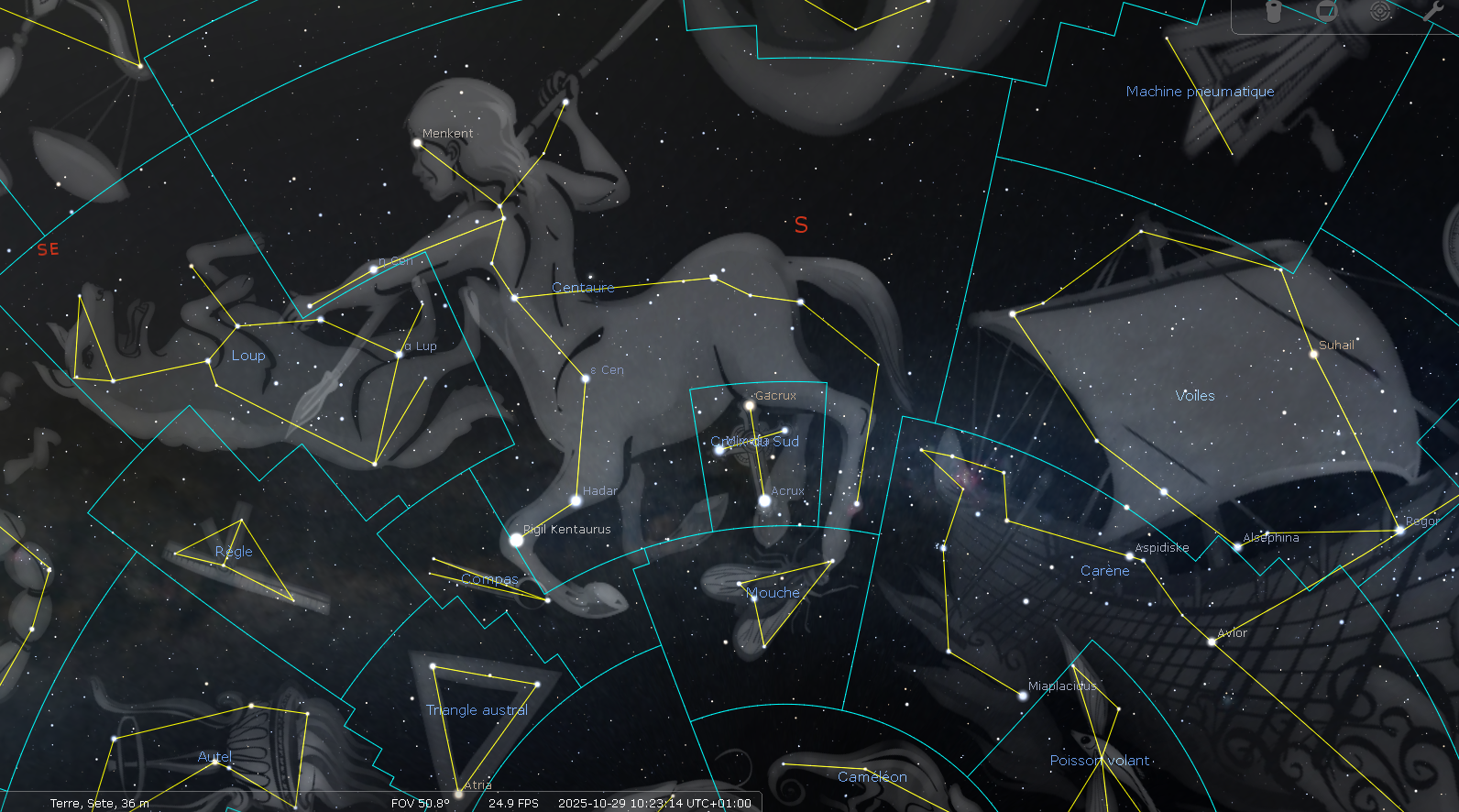
Southern Cross
Photo 3:
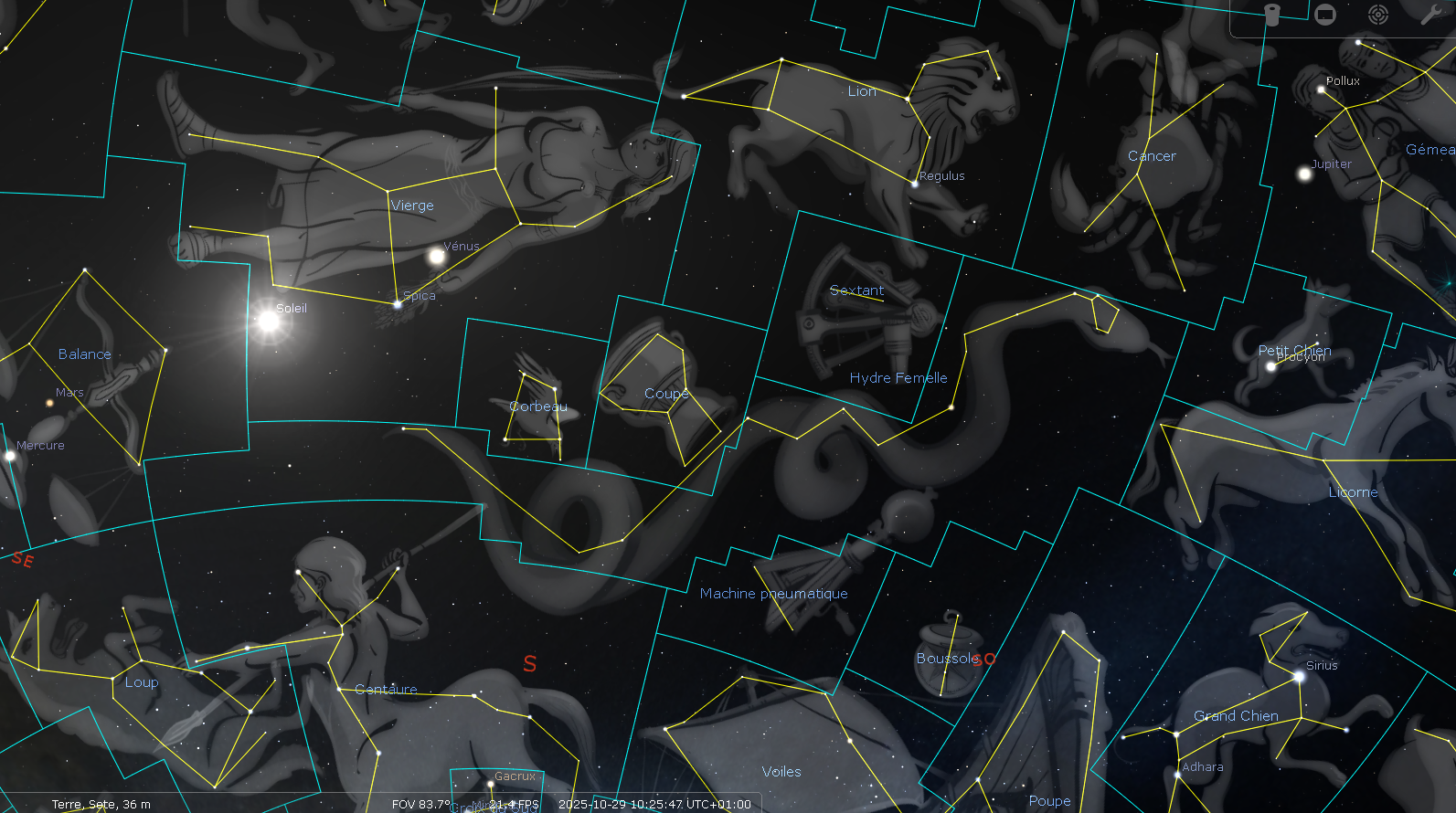
Hydra
Definition of the Zodiac
Of the 88 constellations, the Sun, Moon, and planets appear to move through only 13 constellations: Aries, Taurus, Gemini, Cancer, Leo, Virgo, Libra, Scorpio, Ophiuchus, Sagittarius, Capricorn, Aquarius, and Pisces.
Due to the Earth's axial tilt of 23° 27', the Sun, Moon, and planets are positioned at varying heights in the sky. As a result, the constellations of the zodiac occupy locations either above the celestial equator (northern), below it (southern), or at conjunction (equatorial).
Let's examine these zodiac constellations one by one.
Due to the Earth's axial tilt of 23° 27', the Sun, Moon, and planets are positioned at varying heights in the sky. As a result, the constellations of the zodiac occupy locations either above the celestial equator (northern), below it (southern), or at conjunction (equatorial).
Let's examine these zodiac constellations one by one.
Aries
Two thousand years ago, the Sun was located in this constellation at the time of spring, that is, when the Sun, moving north along the ecliptic, crosses the celestial equator, the projection of the Earth's equator onto the sky.
Spring Equinox. Equal length of day and night. Today, due to the phenomenon of precession, this moment occurs when the Sun is in the constellation of Pisces.
According to mythology, Aries possessed a Golden Fleece and was sent by Hermes to rescue two royal children, Phrysxos and Helle. But Zeus sacrificed this ram and its fleece, which was guarded by a dragon. The Argonauts, led by Jason, Castor, and Pollux, came to conquer it.
The Sun transits Aries between April 19 and May 14.
Taurus
The oldest cultures depict Taurus grappling with the giant Orion. Orion is the constellation below and to the left of Taurus.
It is also possible to imagine that this is the white bull under which Zeus (Jupiter for the Romans) disguised himself to seduce the young Europa. Europa is a moon of Jupiter.
The Sun transits Taurus between May 14 and June 21.
It is also possible to imagine that this is the white bull under which Zeus (Jupiter for the Romans) disguised himself to seduce the young Europa. Europa is a moon of Jupiter.
The Sun transits Taurus between May 14 and June 21.
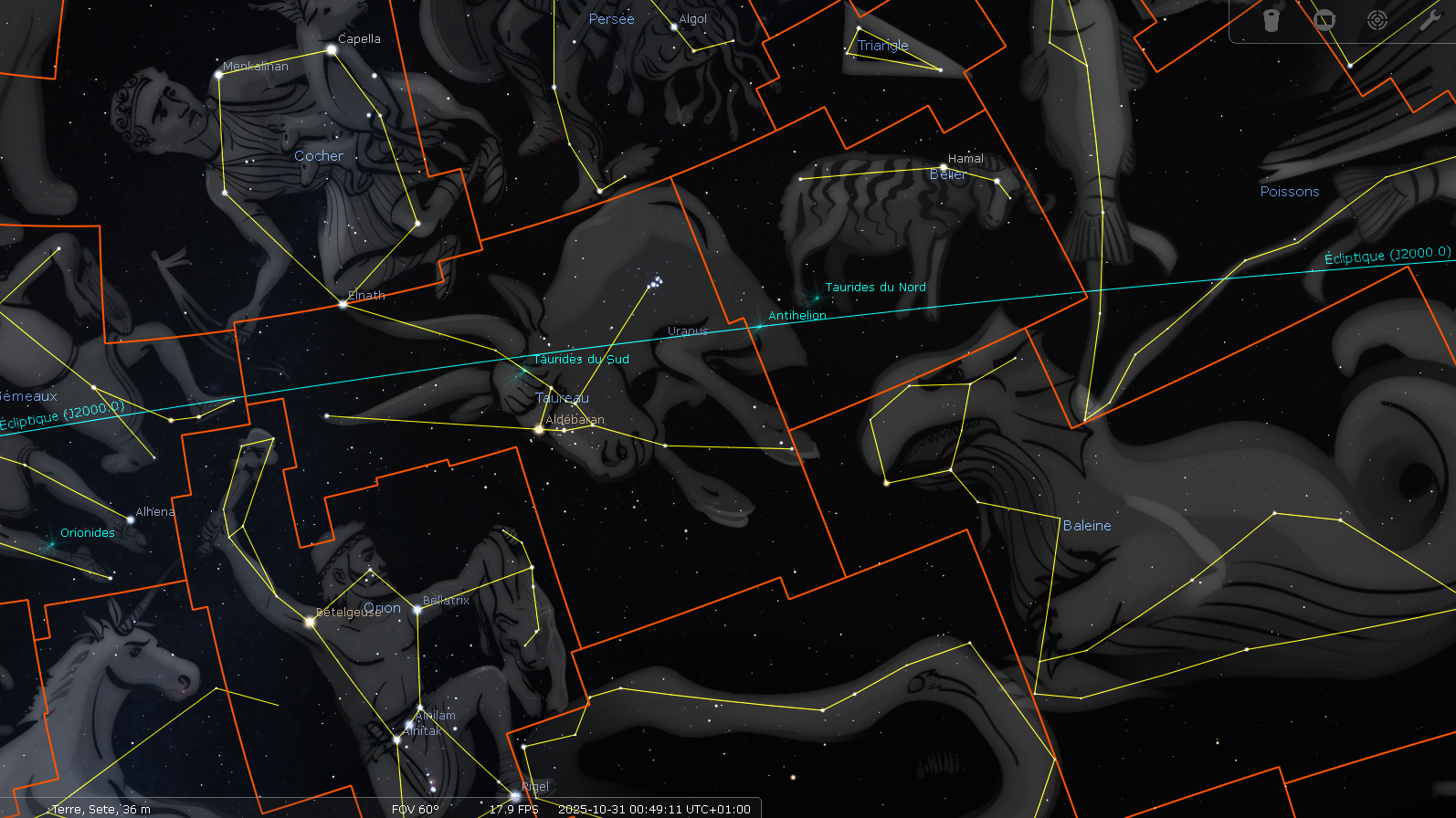
Aries Taurus
Gemini
On the summer solstice, June 21, the Sun is at the cusp of Taurus and Gemini. This is when it is highest in the sky.
Castor and Pollux were Geminis. They became known as the Dioscuri.
Their mother, Leda, was the wife of Tyndareus, King of Sparta.
But Zeus, whose libido is well-known, seduced Leda in the form of a swan. Mythology claims that Pollux's father was Zeus and Castor's father was Tyndareus. Thus, Castor was mortal and Pollux immortal.
What a family affair!
The Sun transits Gemini between June 21 and July 21.
Castor and Pollux were Geminis. They became known as the Dioscuri.
Their mother, Leda, was the wife of Tyndareus, King of Sparta.
But Zeus, whose libido is well-known, seduced Leda in the form of a swan. Mythology claims that Pollux's father was Zeus and Castor's father was Tyndareus. Thus, Castor was mortal and Pollux immortal.
What a family affair!
The Sun transits Gemini between June 21 and July 21.
Cancer
The goddess Hera, wife of Zeus, sent the crab, now Cancer, to kill Heracles (Hercules). But it was trampled and killed by Heracles. To reward its courage, Hera placed it in the constellations of the zodiac.
It is a constellation practically invisible to the naked eye. However, with a simple pair of binoculars, a magnificent open cluster of stars appears. This is the Beehive Cluster, Praesepe. M44 in the Messier catalog.
Let us remember the solar eclipse of August 11, 1999, which passed over France. The Sun was located just on the border between Cancer and Leo.
The Sun crosses Cancer between July 21 and August 11.
It is a constellation practically invisible to the naked eye. However, with a simple pair of binoculars, a magnificent open cluster of stars appears. This is the Beehive Cluster, Praesepe. M44 in the Messier catalog.
Let us remember the solar eclipse of August 11, 1999, which passed over France. The Sun was located just on the border between Cancer and Leo.
The Sun crosses Cancer between July 21 and August 11.
Photo 5
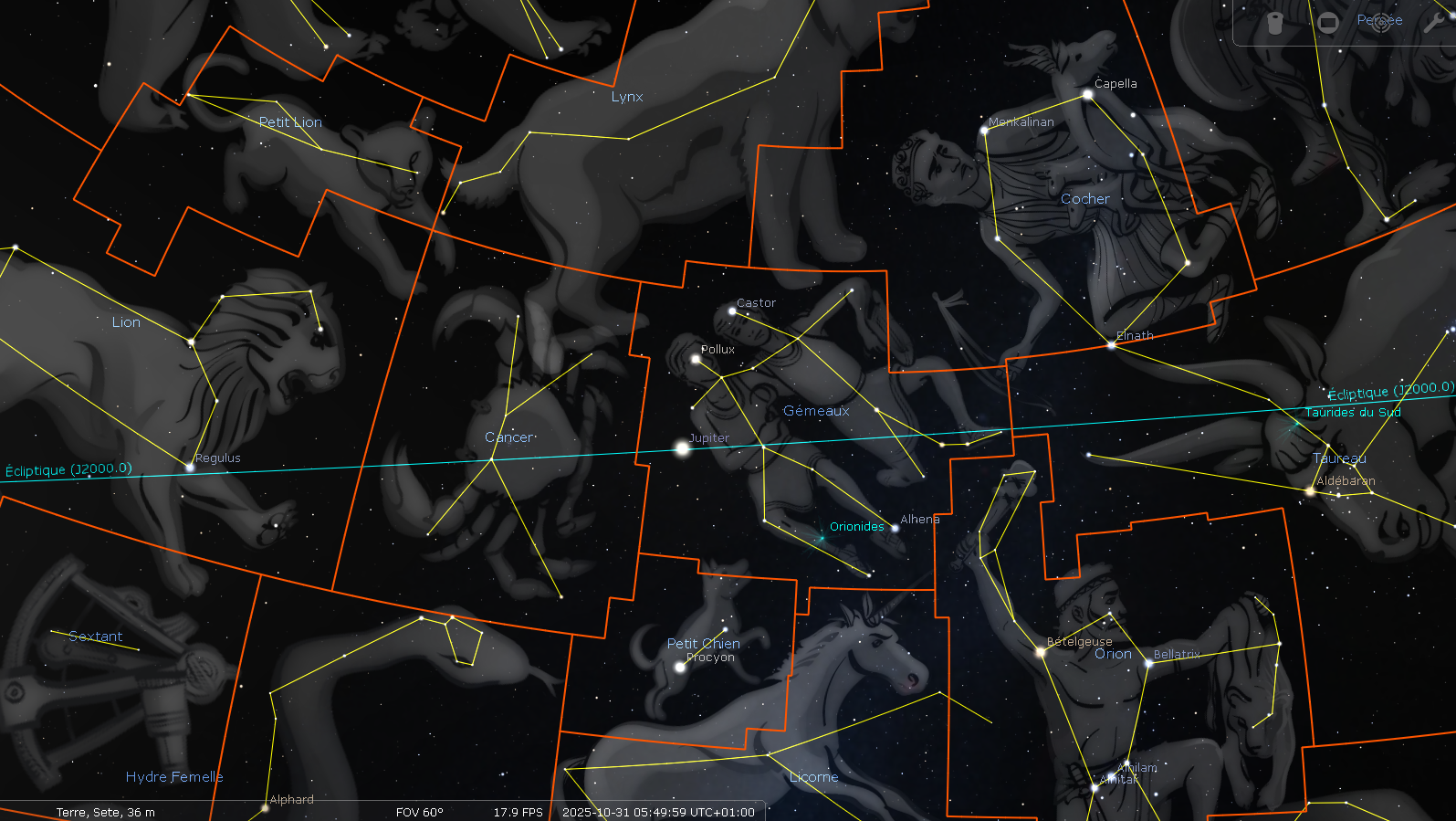
Gemini Cancer
Leo
The Mesopotamians, 5,000 years ago, saw the Sun in this constellation at the time of the summer solstice. Due to the precession of the equinoxes…
This was the symbolic expression of the Sun god.
No doubt this is the Nemean lion that Hercules strangled with his bare hands. The first of the twelve labors.
Leo is one of the few constellations that could resemble a reclining lion with Regulus, a very beautiful star, as its torso or foreleg.
The Sun passes through Leo between August 11 and September 16.
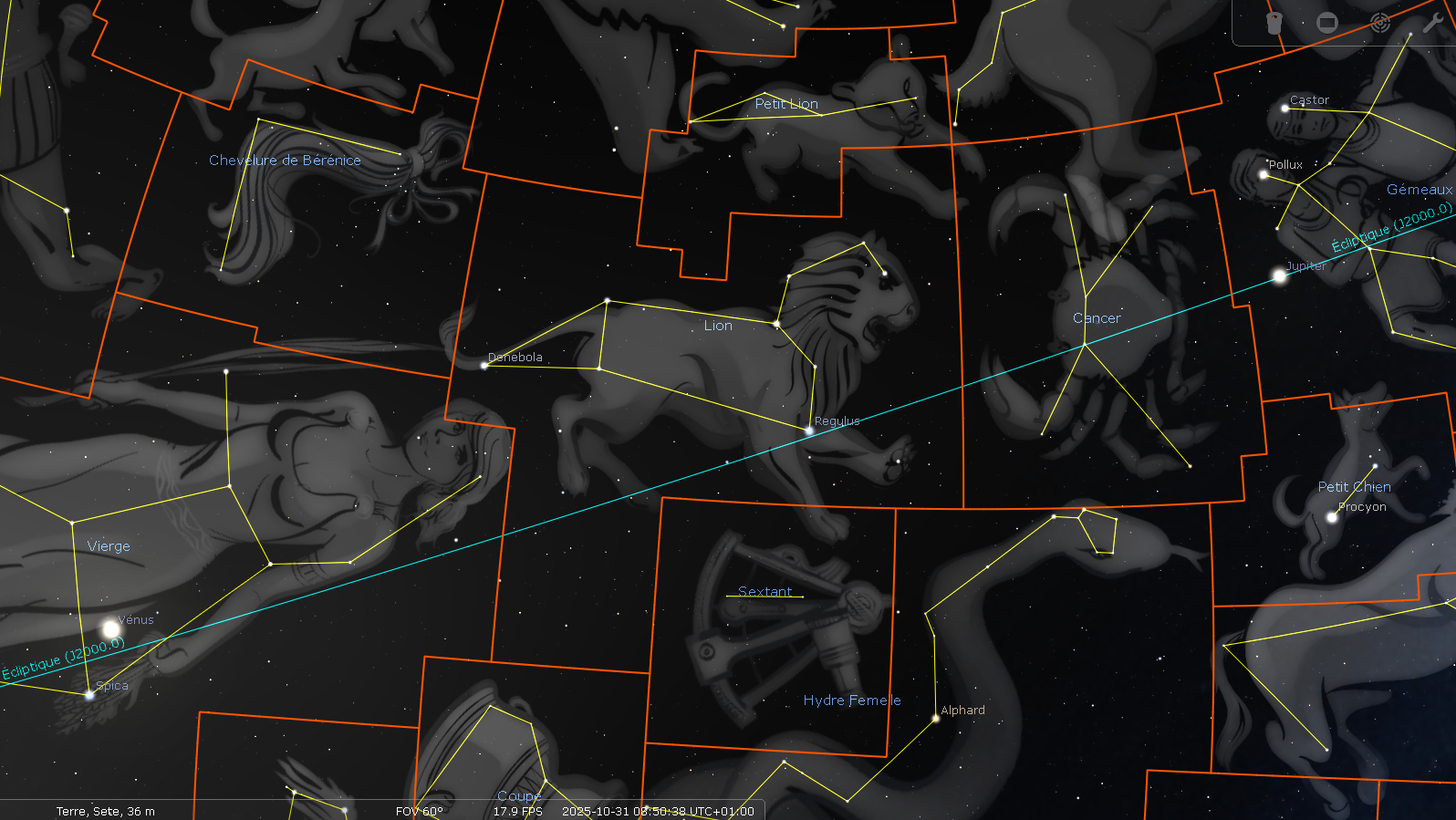
Leo
Virgo
In mythology, Virgo represented the goddess of harvests. Its main star is Spica (the ear of grain in Latin).
It is the second largest constellation in the sky by surface area.
The Sun is located in this constellation at the time of the autumn equinox.
The Sun transits Virgo between September 16 and October 31.
It is the second largest constellation in the sky by surface area.
The Sun is located in this constellation at the time of the autumn equinox.
The Sun transits Virgo between September 16 and October 31.
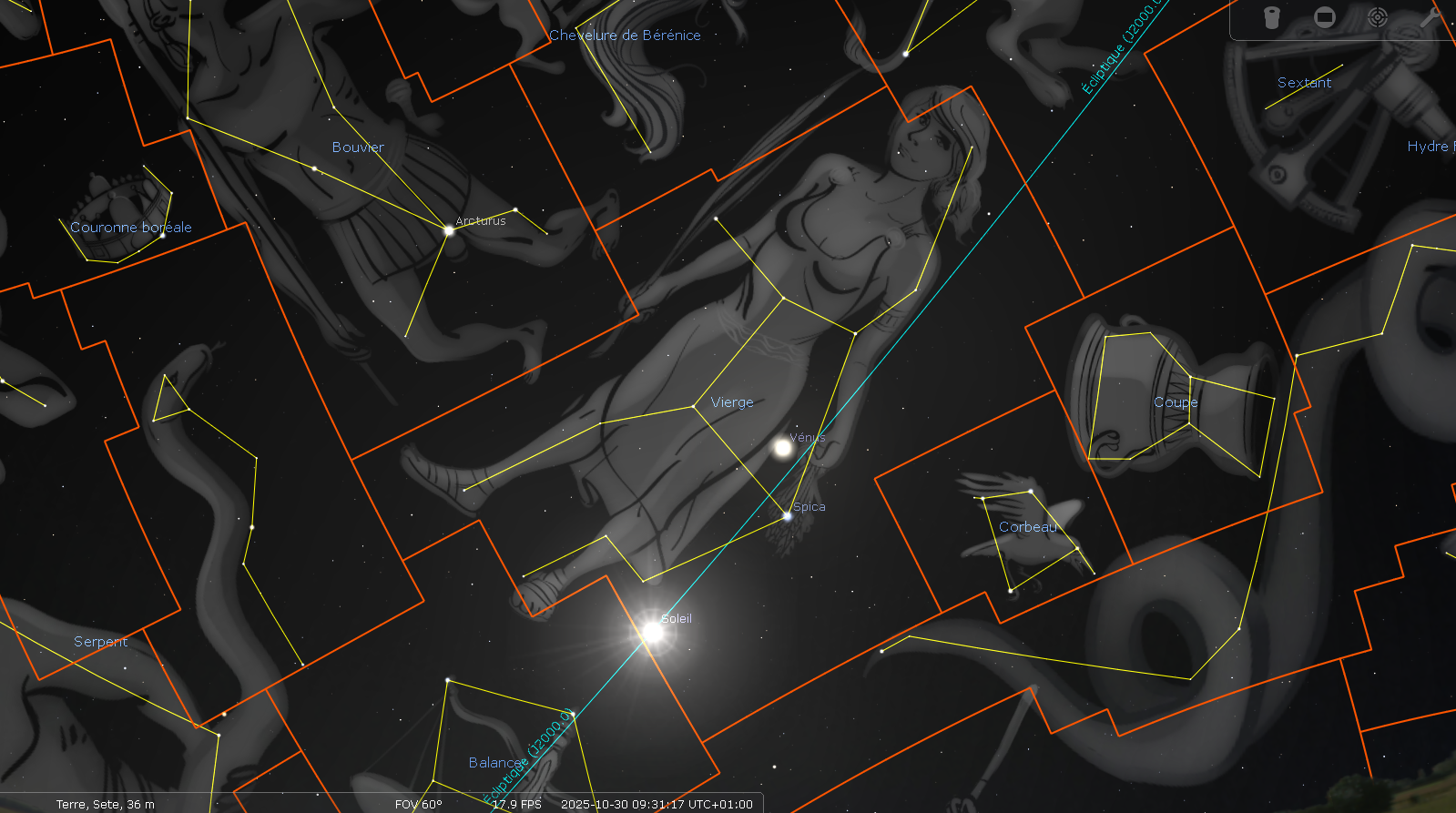
Virgo
Libra
This constellation represents the goddess of justice, whose symbol is the scales.
The names of its main stars attest that in the past, Libra represented the claws of Scorpio. It was later redesigned and considered a constellation in its own right.
To refer once again to the Precession of the Sun, in Ptolemy's time, the equinox occurred with the Sun in Libra. Here again, there was equality between day and night.
The Sun transits Libra between the end of October and November 23.
The names of its main stars attest that in the past, Libra represented the claws of Scorpio. It was later redesigned and considered a constellation in its own right.
To refer once again to the Precession of the Sun, in Ptolemy's time, the equinox occurred with the Sun in Libra. Here again, there was equality between day and night.
The Sun transits Libra between the end of October and November 23.
The Scorpion
Like the Lion, the Scorpion roughly represents the real animal in the sky.
According to legend, it was sent to kill the giant Orion. To restore peace to the heavens, the Scorpion and Orion were placed opposite each other, so they are never seen at the same time.
Within the constellation Scorpius, we find a giant red star: Antares, which means "opposite of Ares." Ares is Mars, the god of war, and the ancients tended to confuse them because of their red color.
The Scorpion is very low on the horizon, so that in mainland France, we don't see its complete outline. Part of it remains below the horizon.
This was a great surprise to me in July 1982 when I arrived in French Guiana to serve with the 3rd Foreign Infantry Regiment (3rd REI). As I stepped off the plane, I had this vision of the entire constellation of Scorpio, high in the sky. We are only 5° latitude, and the Earth is round.
The Sun transits Scorpio between November 23rd and 30th.
According to legend, it was sent to kill the giant Orion. To restore peace to the heavens, the Scorpion and Orion were placed opposite each other, so they are never seen at the same time.
Within the constellation Scorpius, we find a giant red star: Antares, which means "opposite of Ares." Ares is Mars, the god of war, and the ancients tended to confuse them because of their red color.
The Scorpion is very low on the horizon, so that in mainland France, we don't see its complete outline. Part of it remains below the horizon.
This was a great surprise to me in July 1982 when I arrived in French Guiana to serve with the 3rd Foreign Infantry Regiment (3rd REI). As I stepped off the plane, I had this vision of the entire constellation of Scorpio, high in the sky. We are only 5° latitude, and the Earth is round.
The Sun transits Scorpio between November 23rd and 30th.
Ophiuchus
It is also called, particularly by astronomers, by its Latin name, Ophiuchus.
A very old constellation. It is the god of medicine, Aesculapius for the Romans, Asclepius for the Greeks. He holds the tail and the head of the Serpent. This serpent is found in the caduceus of physicians.
It is the famous thirteenth constellation of the zodiac, which astrologers do not include in horoscopes.
The Sun transits Ophiuchus between December 1st and 18th.
A very old constellation. It is the god of medicine, Aesculapius for the Romans, Asclepius for the Greeks. He holds the tail and the head of the Serpent. This serpent is found in the caduceus of physicians.
It is the famous thirteenth constellation of the zodiac, which astrologers do not include in horoscopes.
The Sun transits Ophiuchus between December 1st and 18th.
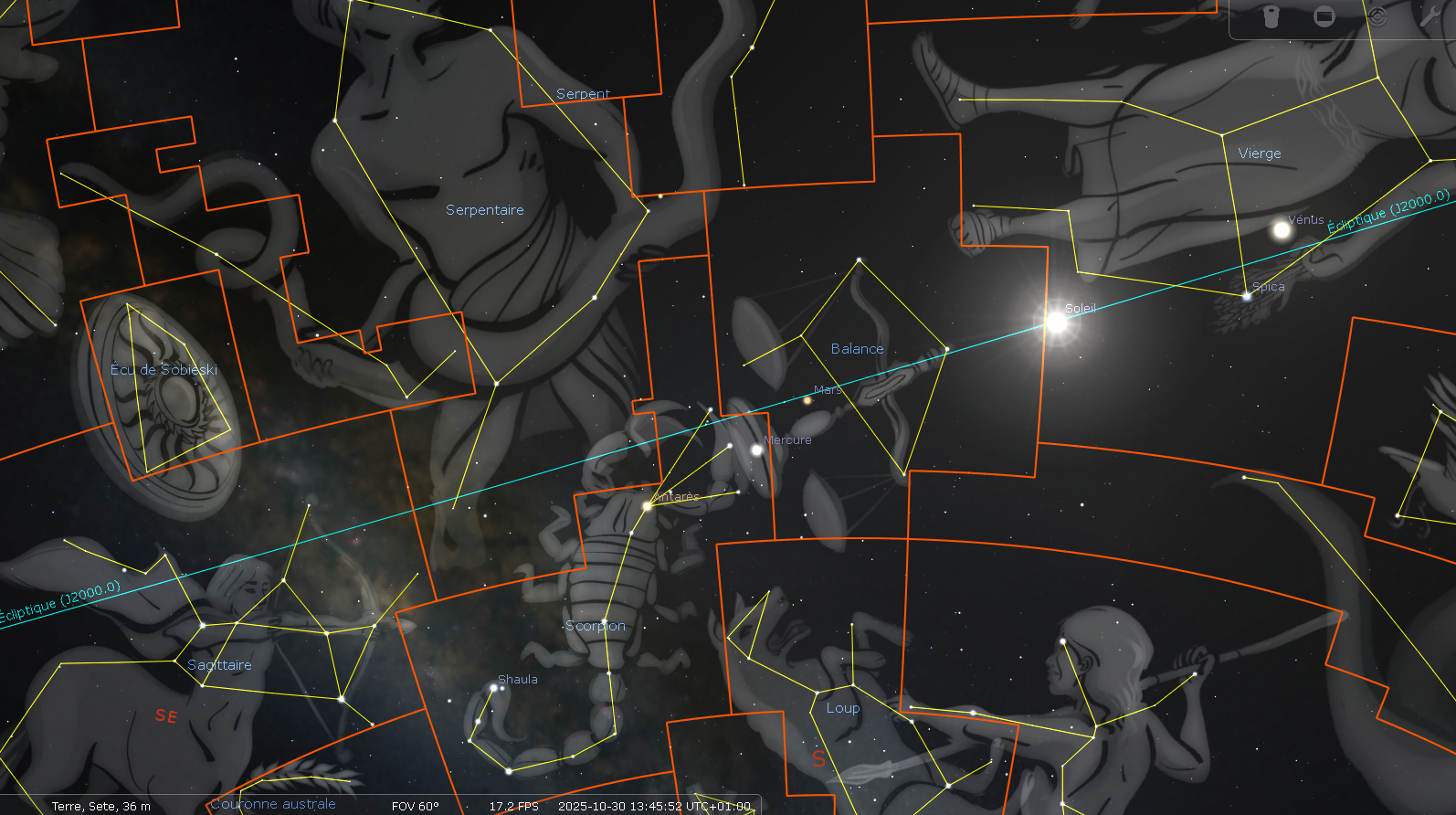
Libra, Scorpio, Ophiuchus
Sagittarius
This constellation is represented on maps by the Centaur, half-man, half-horse, holding a bow pointed towards Scorpio.
In Sagittarius, a multitude of Messier objects. This is normal, as it is the direction of the center of our galaxy, the Milky Way.
The Sun crosses Sagittarius between December 1st and 18th.
In Sagittarius, a multitude of Messier objects. This is normal, as it is the direction of the center of our galaxy, the Milky Way.
The Sun crosses Sagittarius between December 1st and 18th.
Capricorn
This half-goat, half-fish creature is the result of fleeing from Typhon. Pan jumped into a river before he had completely transformed into a goat, and half of his body became a fish tail.
This pleased Zeus, who placed the "sea goat" in the sky.
The Sun crosses Capricorn between January 18th and February 16th.
This pleased Zeus, who placed the "sea goat" in the sky.
The Sun crosses Capricorn between January 18th and February 16th.
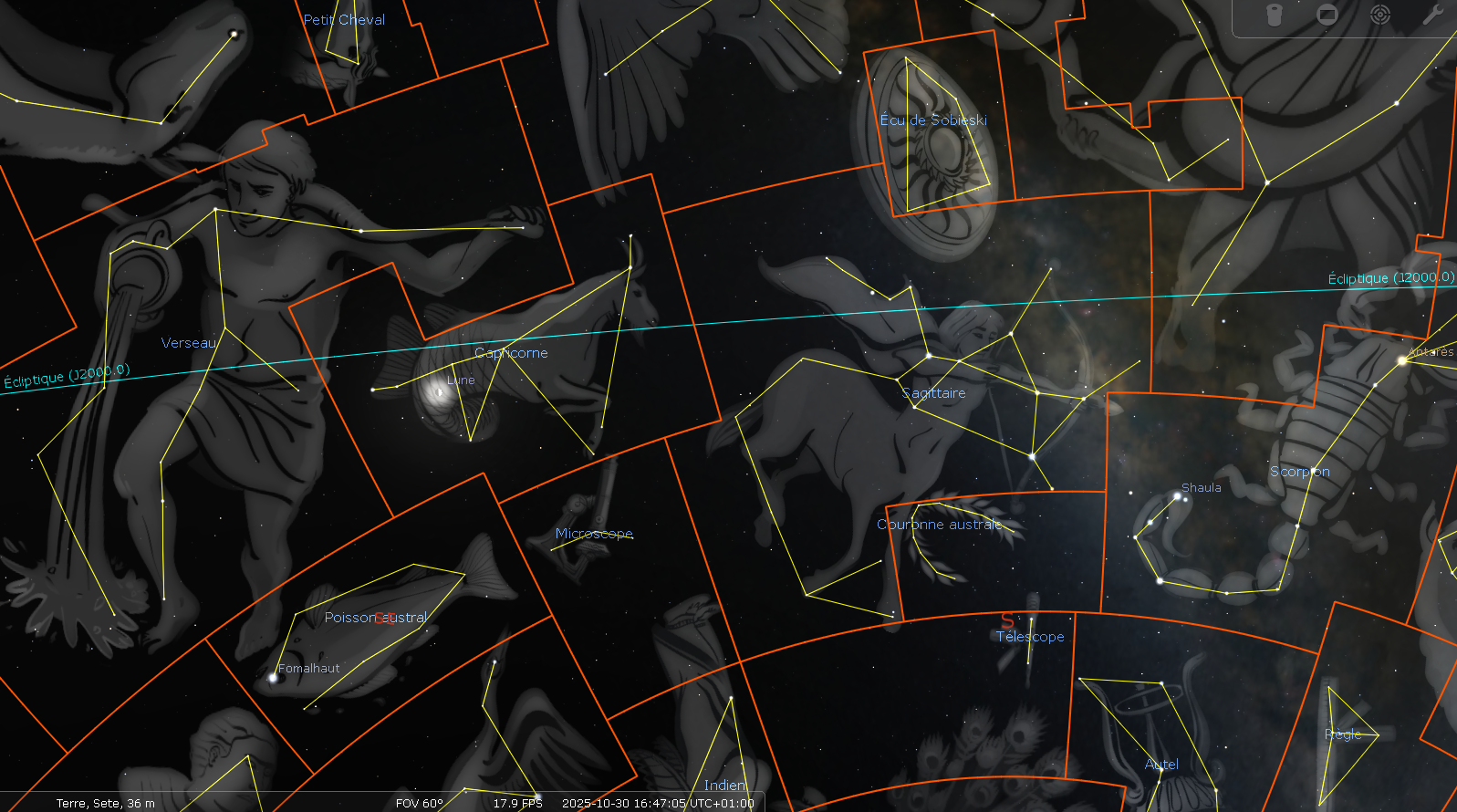
Sagittarius, Capricorn
Aquarius
The Babylonians saw in this constellation a man carrying a jug of water, the source of life.
The Egyptians believed they saw Deucalion, son of Prometheus, sailing on the waters of the Flood.
The Sun crosses Aquarius between February 16 and March 12.
The Egyptians believed they saw Deucalion, son of Prometheus, sailing on the waters of the Flood.
The Sun crosses Aquarius between February 16 and March 12.
Pisces
As with Capricorn, according to mythology, we witness here a leap into the water to escape Typhon, by Aphrodite and her son Eros. They were transformed into fish.
The Sun crosses Pisces between March 12 and April 19.
The Sun crosses Pisces between March 12 and April 19.
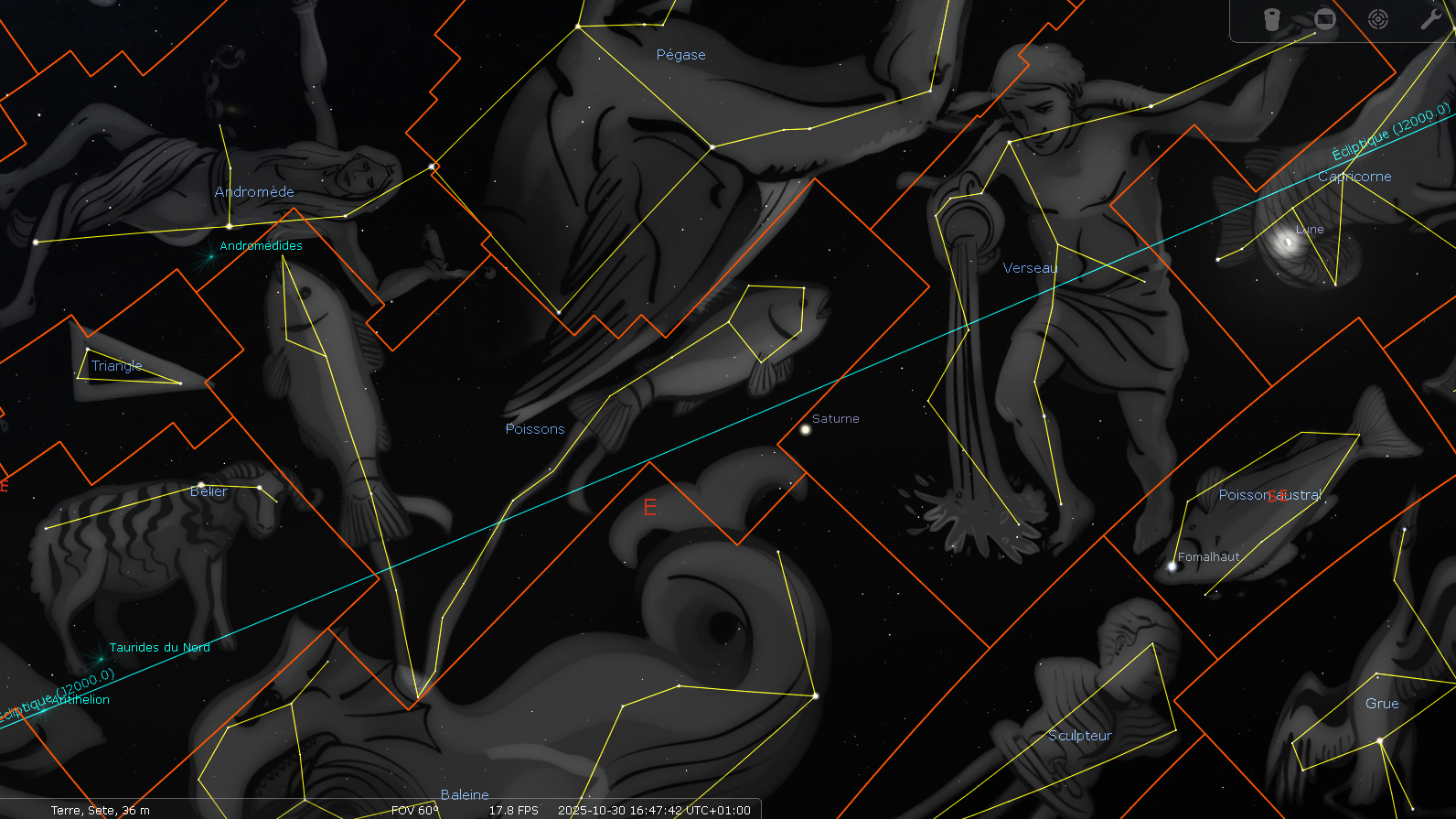
Aquarius, Pisces
By examining these constellations and their characteristics, we can draw certain conclusions.
Eclipses
The entire solar system appears to move within this band of the zodiac. Phenomena observable from Earth can then occur: eclipses and occultations. Indeed, when the Moon passes directly in front of the Sun, it blocks its light, plunging the Earth into shadow. This is a solar eclipse. Similarly, the Moon can pass in front of planets or major stars. These are called occultations. Photo 11 Eclipses
Time the Sun is visible depending on the size of the constellation.
Without wanting to directly attack astrology, I simply wish to remind you of an indisputable reality that many seem to forget.
The Sun moves through the constellations of the zodiac at a roughly constant speed. How can anyone believe that the Sun will remain in a small constellation for one month and in a large one for another? This defies the most basic logic.
You yourself, driving at 50 km/h, will cross a small village in less time than a large city. So, why this obsession with the Sun?
Time the Sun is visible depending on the size of the constellation.
Without wanting to directly attack astrology, I simply wish to remind you of an indisputable reality that many seem to forget.
The Sun moves through the constellations of the zodiac at a roughly constant speed. How can anyone believe that the Sun will remain in a small constellation for one month and in a large one for another? This defies the most basic logic.
You yourself, driving at 50 km/h, will cross a small village in less time than a large city. So, why this obsession with the Sun?
Period of visibility.
Because the Sun appears to be positioned in front of the stars of these constellations at any given time, but it's clear that, contrary to popular belief, it's impossible to see your own constellation in the sky on your birthday. However, every night, five or six constellations of the zodiac are visible simultaneously.
Modern man, increasingly living in cities which he protects with streetlights for security reasons, no longer sees the sky. Television and security keep him confined and deprive him of the magnificent spectacle of the celestial vault.
Ancient civilizations lived in harmony with the sky. And to immortalize the objects, people, and animals that were dear to them, they "tossed" them into the sky like banners or trophies. I can only encourage you to rediscover these constellations.
Night after night, for a few moments, immerse yourself once again in this stellar immensity that will bring you calm, serenity, reverie, and well-being. Solar System Journey (see below)