






All this is happening above our heads
When the Sun Dies
By Michel Gravereau
We have become accustomed to thinking that the beginning of the Universe was marked by that immense explosion called the "Big Bang," about 15 billion years ago.
Our solar system was born much later, only 4.8 billion years ago. At the center, the Sun, our star, reigns supreme. It seems eternal, indestructible, and yet, like everything else, like all stars, it was born, it lives, and it will die.
It is currently halfway through its existence.
We have become accustomed to thinking that the beginning of the Universe was marked by that immense explosion called the "Big Bang," about 15 billion years ago.
Our solar system was born much later, only 4.8 billion years ago. At the center, the Sun, our star, reigns supreme. It seems eternal, indestructible, and yet, like everything else, like all stars, it was born, it lives, and it will die.
It is currently halfway through its existence.
Here, in broad strokes, is the chronicle of this predicted death.
In about 5 billion years, it will swell enormously, reaching a size 20 times greater than its current size, and will begin to shine brighter than ever before. It will then engulf most of the planets in the Solar System, including Earth, in its blaze.
Its programmed end will be full of twists and turns. Its brightness, size, and temperature will fluctuate until it reaches the final stage of its life, becoming a dark, cold body that will slowly burn out.
For us, who have warmed ourselves in its light since the beginning of time, it's hard to imagine that it isn't eternal.
During this long agony, and contrary to what one might think, the planets closest to it won't freeze solid but will be charred by the Sun's intense heat.
In about 5 billion years, it will swell enormously, reaching a size 20 times greater than its current size, and will begin to shine brighter than ever before. It will then engulf most of the planets in the Solar System, including Earth, in its blaze.
Its programmed end will be full of twists and turns. Its brightness, size, and temperature will fluctuate until it reaches the final stage of its life, becoming a dark, cold body that will slowly burn out.
For us, who have warmed ourselves in its light since the beginning of time, it's hard to imagine that it isn't eternal.
During this long agony, and contrary to what one might think, the planets closest to it won't freeze solid but will be charred by the Sun's intense heat.
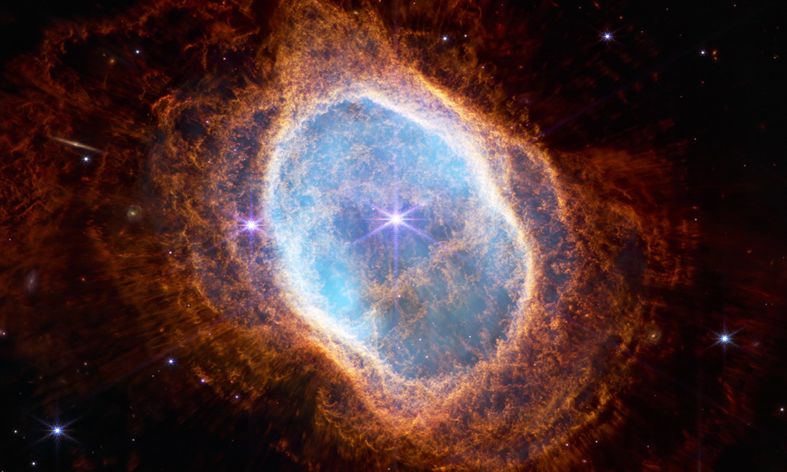
At its core, the temperature will exceed 100 million degrees. Its brightness will become unbearable; it will shine 10,000 times brighter than it does today. This star, already unrecognizable, will continue to grow, and its outer layers will cool, turning red. The planets closest to it (Mercury, Venus, Earth, and Mars) will disappear, engulfed by its fires, sterilized by the immense radiation of the monster.
Some imagine that Earthlings will be far away, sailing towards other worlds to colonize. Yeah, right!
Some imagine that Earthlings will be far away, sailing towards other worlds to colonize. Yeah, right!
The heart of our star.
Finally, the moment will come when the Sun, or at least what will remain of it, will eject its outer layers into space: this will be the last gasp before the end.
At the center of the outer layers, only the heart of the dying star will remain: a very faint object, a hundred times smaller than the current Sun, which astronomers call a white dwarf. Shining with a very faint light, this object will take tens of billions of years to completely burn out.
At the center of the outer layers, only the heart of the dying star will remain: a very faint object, a hundred times smaller than the current Sun, which astronomers call a white dwarf. Shining with a very faint light, this object will take tens of billions of years to completely burn out.
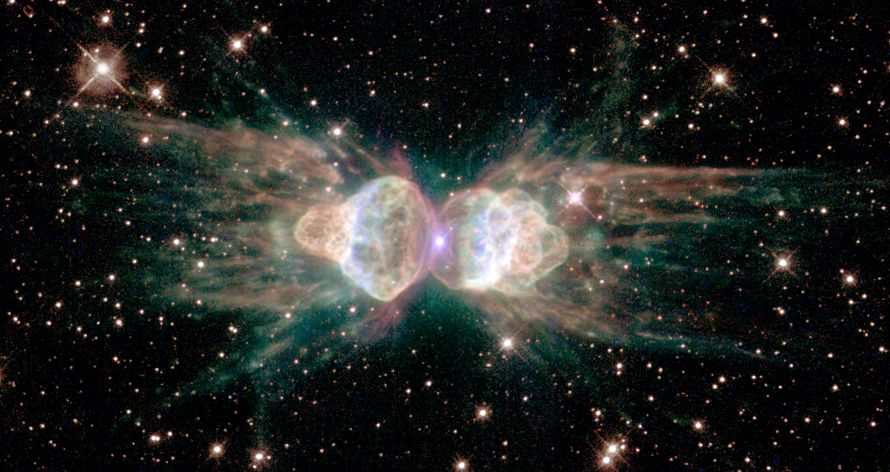
Observing planetary nebulae.
These gaseous envelopes that stars, like the Sun, eject at the end of their lives are spotted by astronomers all over the cosmos. For them, they are clear proof that stars are living their final moments.
Some of these envelopes resemble smoke rings (originally, they were mistaken for planets, hence their current name of "planetary nebulae"), while others take on stranger shapes. They all share intense colors. At their center, we most often observe the small star, the white dwarf, slowly fading away.
Some of these envelopes resemble smoke rings (originally, they were mistaken for planets, hence their current name of "planetary nebulae"), while others take on stranger shapes. They all share intense colors. At their center, we most often observe the small star, the white dwarf, slowly fading away.
.jpg?t=aeb8a500_42ca_451a_ab7f_8e5528b4f20b)
This is how our star, the Sun, will disappear.
For the largest stars, the death will be far more cataclysmic. They will become red giants and then explode in a spectacular display, leaving no room for the white dwarf. Nothing will remain of the star but particles that will gently disperse into space as a supernova.
Much later, under the influence of universal gravitation, these particles, at the end of a long dance, will form a new solar system. Recycling exists, even in the sky.
Upcoming Events
This section informs you about foreseeable events in the fields of pure astronomy and space exploration.
Astronomical Events
February 25: The Moon at perigee; distance from Earth: 370,135 km.
March 3: Total lunar eclipse, not visible from mainland France.
March 20: Spring equinox.
May 7 and 8: Sunset under the Arc de Triomphe from the Place de la Concorde. May 9, 10, and 11: Sunset under the Arc de Triomphe from the Champs-Élysées roundabout.
June 21: Summer solstice.
July 31, August 1, 2, and 3: Sunset under the Arc de Triomphe from the Champs-Élysées roundabout.
August 3, 4, and 5: Sunset under the Arc de Triomphe from the Place de la Concorde.
August 12: Total solar eclipse, visible in its partial phase in mainland France
August 28: Partial lunar eclipse in mainland France.
September 14: Venus appears behind the Moon.
September 23: Autumnal Equinox.
December 21: Winter Solstice.
Bear Meteor Shower.
Space Exploration
ISS: French astronaut Sophie Adenot joined the crew aboard the ISS.
She became the 11th French astronaut and the 2nd woman, the first being Claudie Aigne.
Artemis 2 launch to the Moon: Date set: March 7. However, due to a malfunction in the helium flow in one of the SLS rocket stages, the launch will almost certainly not take place on that date.
To be continued...
For the largest stars, the death will be far more cataclysmic. They will become red giants and then explode in a spectacular display, leaving no room for the white dwarf. Nothing will remain of the star but particles that will gently disperse into space as a supernova.
Much later, under the influence of universal gravitation, these particles, at the end of a long dance, will form a new solar system. Recycling exists, even in the sky.
Upcoming Events
This section informs you about foreseeable events in the fields of pure astronomy and space exploration.
Astronomical Events
February 25: The Moon at perigee; distance from Earth: 370,135 km.
March 3: Total lunar eclipse, not visible from mainland France.
March 20: Spring equinox.
May 7 and 8: Sunset under the Arc de Triomphe from the Place de la Concorde. May 9, 10, and 11: Sunset under the Arc de Triomphe from the Champs-Élysées roundabout.
June 21: Summer solstice.
July 31, August 1, 2, and 3: Sunset under the Arc de Triomphe from the Champs-Élysées roundabout.
August 3, 4, and 5: Sunset under the Arc de Triomphe from the Place de la Concorde.
August 12: Total solar eclipse, visible in its partial phase in mainland France
August 28: Partial lunar eclipse in mainland France.
September 14: Venus appears behind the Moon.
September 23: Autumnal Equinox.
December 21: Winter Solstice.
Bear Meteor Shower.
Space Exploration
ISS: French astronaut Sophie Adenot joined the crew aboard the ISS.
She became the 11th French astronaut and the 2nd woman, the first being Claudie Aigne.
Artemis 2 launch to the Moon: Date set: March 7. However, due to a malfunction in the helium flow in one of the SLS rocket stages, the launch will almost certainly not take place on that date.
To be continued...