





All this is happening above our heads
The Sky Is Falling on our heads
By Michel Gravereau.
All children are fascinated by dinosaurs, strange and imposing creatures that we no longer encounter in our meadows, but only in museums, thanks to the tireless work of paleontologists who search for traces and bones of these animals that disappeared 65 million years ago.
Better than anyone, these witnesses to the past know what "the sky is falling." Indeed, their extinction was due to a brutal collision between our planet and a body that emerged from the night: an asteroid 12 km in diameter. The point of impact likely occurred in the Gulf of Mexico, on the Yucatan Peninsula.
The shock was so powerful that it triggered tsunamis, fires, and propelled an immense amount of dust into the atmosphere, darkening the sky so completely for 800 years that vegetation died and the dinosaurs, vegetarians before their time, perished. It was their extinction.

Inevitable Collision?
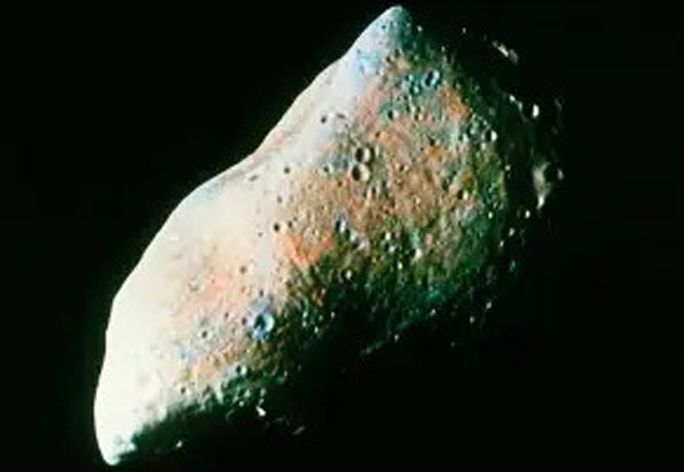
Witnesses to the birth of our solar system, millions of asteroids orbit our Sun. They vary greatly in size, from just a few centimeters for the smallest to less than a kilometer for most. We have identified only a few dozen that exceed 200 km in diameter. The largest is named Vesta and has an average diameter of 530 km. Their shapes are more reminiscent of potatoes, suppositories, or peanuts than spheres. No two are alike!
Their composition is also such that they can be classified as Carbonaceous, resembling pieces of coal, as black as ebony. They represent 75% of asteroids.
Some are rocky, meaning that silicates or minerals make up their composition.
Finally, the third category fascinates some scientists. Some asteroids are metallic, simply composed of iron or nickel.
Discovery of the first asteroid.
On January 1, 1801, while searching for a star from the Palermo Observatory, the Italian Giuseppe Piazzi discovered Ceres in the asteroid belt. History tells us that Napoleon, an amateur astronomer, upon learning of this discovery during a campaign, wanted to impose a different name.
Since August 24, 2006, like Pluto, Ceres has been classified as a dwarf planet. Its diameter is approximately 950 km, and it has a spherical shape. A probe, Dawn, visited this celestial body in 2015, after having closely observed Vesta.
Witnesses to the birth of our solar system, millions of asteroids orbit our Sun. They vary greatly in size, from just a few centimeters for the smallest to less than a kilometer for most. We have identified only a few dozen that exceed 200 km in diameter. The largest is named Vesta and has an average diameter of 530 km. Their shapes are more reminiscent of potatoes, suppositories, or peanuts than spheres. No two are alike!
Their composition is also such that they can be classified as Carbonaceous, resembling pieces of coal, as black as ebony. They represent 75% of asteroids.
Some are rocky, meaning that silicates or minerals make up their composition.
Finally, the third category fascinates some scientists. Some asteroids are metallic, simply composed of iron or nickel.
Discovery of the first asteroid.
On January 1, 1801, while searching for a star from the Palermo Observatory, the Italian Giuseppe Piazzi discovered Ceres in the asteroid belt. History tells us that Napoleon, an amateur astronomer, upon learning of this discovery during a campaign, wanted to impose a different name.
Since August 24, 2006, like Pluto, Ceres has been classified as a dwarf planet. Its diameter is approximately 950 km, and it has a spherical shape. A probe, Dawn, visited this celestial body in 2015, after having closely observed Vesta.

Millions of asteroids have been discovered since then. Most of them orbit between Mars and Jupiter in what is called the asteroid belt, about 400 million kilometers from the Sun.
Beyond Neptune, the Kuiper Belt also harbors asteroids. But they are so distant that our telescopes can only see those several tens of kilometers across.
Other asteroids, called Trojans, share the same orbit as each of the planets. They are trapped by physical forces "in front" and "behind" each planet. Jupiter has more than 8,000 Trojan asteroids (compared to nine known ones for Mars and two for Earth).
Billions upon billions of interstellar asteroids, escaped from other solar systems, wander the Universe. Some stray and cross our Solar System. Oumuamua, for example, paid us a brief visit in 2017 before heading back into space.
Witnesses to our past
Asteroids have remained virtually unchanged since the formation of the Solar System 4.5 billion years ago. They are the remnants of the primordial materials from which the planets formed. As such, they interest scientists because it is believed they may have contributed to the development of life on Earth, bringing with them water or organic molecules.
Asteroids are witnesses to the origin of the Solar System, like fossils for paleontologists or DNA for geneticists. An asteroid is called a meteor when it passes through our atmosphere. If it reaches the ground, it is then called a meteorite. NASA estimates that more than 230 meteorites weighing over 10 grams "rain" down on Earth every day. Scientists can thus study the few specimens they find.
But since the 1990s, space probes have been flying over asteroids, revealing details invisible to ground-based telescopes: their shape, their surface composition, and so on. Other satellites are also tasked with cataloging them. Like Gaia, which, starting in 2014, mapped and measured tens of thousands of asteroids.
Obtaining samples.
The holy grail for scientists is to collect pieces of asteroids in space and bring them back to Earth intact! Several space missions have been conducted for this purpose:
Hayabusa: In 2010, the Japanese space agency (JAXA) brought back to Earth 1,500 grains collected from the asteroid Itokawa asteroid.
Beyond Neptune, the Kuiper Belt also harbors asteroids. But they are so distant that our telescopes can only see those several tens of kilometers across.
Other asteroids, called Trojans, share the same orbit as each of the planets. They are trapped by physical forces "in front" and "behind" each planet. Jupiter has more than 8,000 Trojan asteroids (compared to nine known ones for Mars and two for Earth).
Billions upon billions of interstellar asteroids, escaped from other solar systems, wander the Universe. Some stray and cross our Solar System. Oumuamua, for example, paid us a brief visit in 2017 before heading back into space.
Witnesses to our past
Asteroids have remained virtually unchanged since the formation of the Solar System 4.5 billion years ago. They are the remnants of the primordial materials from which the planets formed. As such, they interest scientists because it is believed they may have contributed to the development of life on Earth, bringing with them water or organic molecules.
Asteroids are witnesses to the origin of the Solar System, like fossils for paleontologists or DNA for geneticists. An asteroid is called a meteor when it passes through our atmosphere. If it reaches the ground, it is then called a meteorite. NASA estimates that more than 230 meteorites weighing over 10 grams "rain" down on Earth every day. Scientists can thus study the few specimens they find.
But since the 1990s, space probes have been flying over asteroids, revealing details invisible to ground-based telescopes: their shape, their surface composition, and so on. Other satellites are also tasked with cataloging them. Like Gaia, which, starting in 2014, mapped and measured tens of thousands of asteroids.
Obtaining samples.
The holy grail for scientists is to collect pieces of asteroids in space and bring them back to Earth intact! Several space missions have been conducted for this purpose:
Hayabusa: In 2010, the Japanese space agency (JAXA) brought back to Earth 1,500 grains collected from the asteroid Itokawa asteroid.
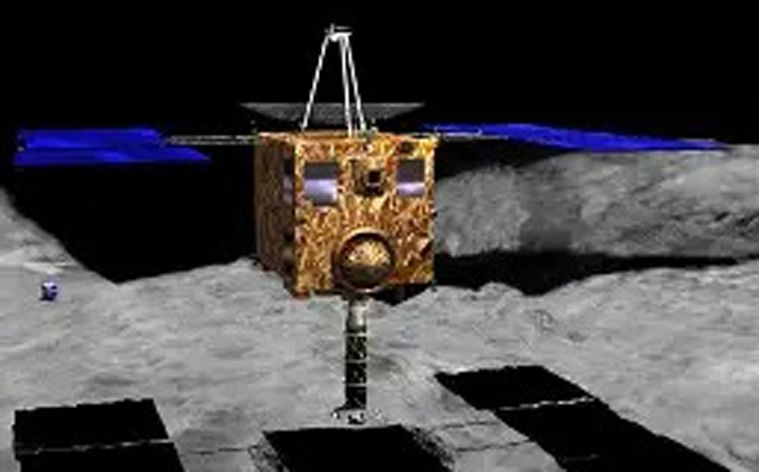
Hayabusa 2: In 2014, JAXA collected 5.4 grams of samples from the asteroid Ryugu, which were returned to Earth in 2020. The probe also carried MASCOT, a small lander developed by France and Germany that performs measurements directly on Ryugu.
OSIRIS-REx: This American probe collected more than 120 grams from the asteroid Bennu, which returned to Earth in 2023.

A 1 km cube of metallic asteroid is estimated to contain 7 billion tons of iron, 1 billion tons of nickel, as well as cobalt (a rare metal), platinum, and other minerals. Some therefore see asteroids as space mines. However, the technological challenges of mining them remain enormous.
Comet or asteroid?
It's sometimes easy to get them mixed up. While an asteroid is a completely dead, geologically inert body, comets have a nucleus composed of ices that can be reactivated as they approach the Sun. Hence their tail, their "coma," which leaves trails of dust in space and which Earth may cross in its wild orbit around the Sun. By violently colliding with these dust grains, the atmosphere generates such friction that they light up in the darkness of our nights, creating shooting stars. Throughout our days, day or night, Earth "sweeps" through space, and tons of dust fall to our planet.
Among the asteroids in the main asteroid belt, some are closely monitored because they cross Earth's orbit. These are the famous near-Earth asteroids. Computers are constantly integrating the various orbits of asteroids and Earth, processing data to determine the likelihood of a collision. Sleep soundly, folks, the forecasts are entirely optimistic for the next few hundred years. But the appearance of an unknown comet from the far reaches of our solar system is always a possibility.
Astronomers are constantly scanning the skies to detect asteroids that could pose a threat to our planet. Space agencies are also considering ways to avoid a potential impact, such as NASA's DART mission.
In 2022, a spacecraft crashed into the small asteroid Dimorphos at 24,000 km/h, demonstrating that its trajectory could be altered. Could we draw a parallel? While some military engineers at the DGA (French Directorate General of Armaments) are calculating how to protect themselves from drones, astronomers are asking themselves the same question, but for asteroids. Each has their own problem.
Comet or asteroid?
It's sometimes easy to get them mixed up. While an asteroid is a completely dead, geologically inert body, comets have a nucleus composed of ices that can be reactivated as they approach the Sun. Hence their tail, their "coma," which leaves trails of dust in space and which Earth may cross in its wild orbit around the Sun. By violently colliding with these dust grains, the atmosphere generates such friction that they light up in the darkness of our nights, creating shooting stars. Throughout our days, day or night, Earth "sweeps" through space, and tons of dust fall to our planet.
Among the asteroids in the main asteroid belt, some are closely monitored because they cross Earth's orbit. These are the famous near-Earth asteroids. Computers are constantly integrating the various orbits of asteroids and Earth, processing data to determine the likelihood of a collision. Sleep soundly, folks, the forecasts are entirely optimistic for the next few hundred years. But the appearance of an unknown comet from the far reaches of our solar system is always a possibility.
Astronomers are constantly scanning the skies to detect asteroids that could pose a threat to our planet. Space agencies are also considering ways to avoid a potential impact, such as NASA's DART mission.
In 2022, a spacecraft crashed into the small asteroid Dimorphos at 24,000 km/h, demonstrating that its trajectory could be altered. Could we draw a parallel? While some military engineers at the DGA (French Directorate General of Armaments) are calculating how to protect themselves from drones, astronomers are asking themselves the same question, but for asteroids. Each has their own problem.